
THE CHALLENGE: A business-tech program in the portfolio was renamed to include AI, better reflecting its evolving curriculum and market relevance.However, the new name also introduced a challenge: how could we clearly differentiate the program in an increasingly crowded AI and technology education market?
THE PROJECT: Developing a differentiated positioning strategy and narrative for the program grounded in customer insights, competitive research and the program’s unique combination of business, technology and innovation.
This project was developed during my role as Product Marketing Specialist at IE Business School. IE Business school is one of the top business schools worldwide, ranked #6 in the world by Forbes for the Best Business Schools List.
Research & Analysis
I started by understanding who the program was really designed for and where it sat within the competitive landscape.
Student & Talent Analysis
I analyzed data from previous cohorts to understand:
- Students’ academic and professional backgrounds
- The balance between business and technical profiles
- Their current roles and career trajectories
- The skills and career paths the program was attracting
Competitive Benchmarking
I mapped both external competitors and internal programs across key dimensions, including business/strategy orientation and technical intensity.
I also analyzed competitor websites and messaging to understand:
- How they positioned their programs
- What they used as their key differentiators
- How they communicated AI and emerging technologies
- Which language and value propositions dominated the category
Defining the Audience
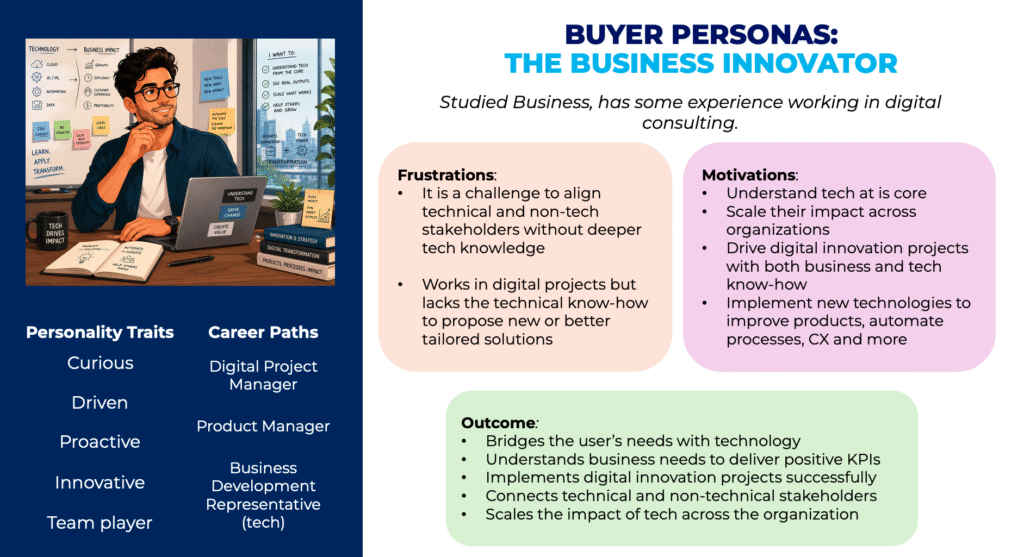
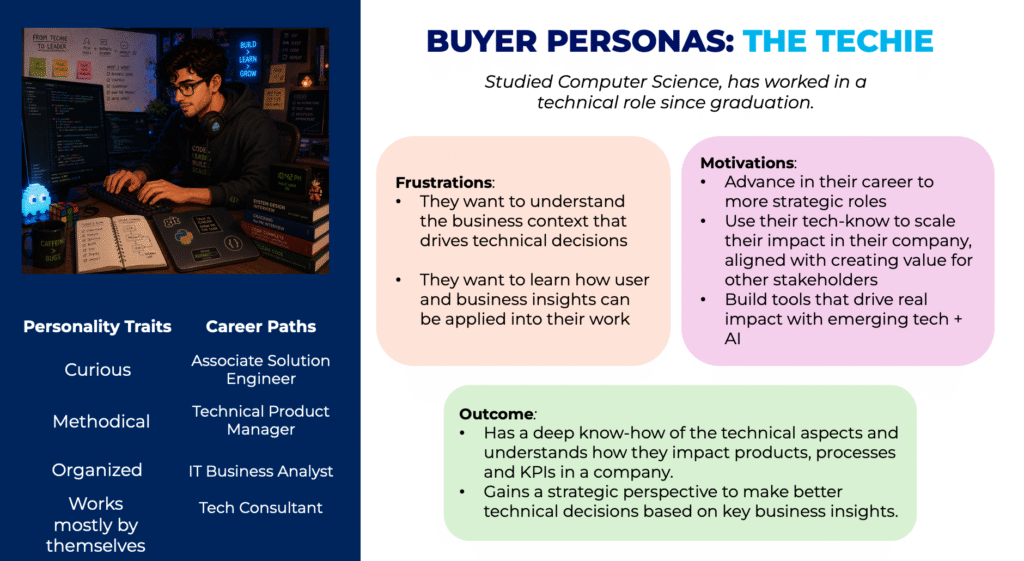
The research revealed two main personas: a Business Innovator profile and a Techie Profile. One came from a business background, and the other from a technical one. Both shared the same ambition: to use technology to create greater business impact.
The Business Innovator
A business professional with experience in digital projects, looking to develop the technical understanding needed to turn ideas into better solutions.
They want to:
- Understand technology at its core
- Lead digital innovation projects
- Connect business needs with technical possibilities
- Use emerging technologies to improve products, processes and customer experiences
The transformation:
From a business professional to a technology-enabled innovator.
The Techie
A technically trained professional with experience in technology roles, looking to move beyond execution and understand the business context behind technical decisions.
They want to:
- Progress into more strategic roles
- Understand how business and user insights influence technology decisions
- Use their technical expertise to create greater organizational impact
- Build solutions that generate measurable business value
The transformation:
From a technical expert to a strategic technology leader.
Key Insights
The research revealed three important opportunities:
1. The audience was hybrid
The majority came from business backgrounds but wanted to develop a deeper understanding of technology and its practical application.
A smaller segment came from more technical backgrounds and were looking to expand their strategic and leadership capabilities.
2. The positioning needed to bridge both worlds
Competitor programs tended to lean heavily toward either business/strategy or technical depth.
The opportunity was to position this program in the space between the two: strong strategic business foundations combined with meaningful technical intensity.
3. Innovation could become the connecting idea
The program already incorporated innovation across its curriculum. Rather than presenting AI, technology and business as separate capabilities, I saw an opportunity to connect them through an innovation journey by using an innovation framework to showcase the curriculum and key learning areas.
Strategic Direction
The research revealed a clear positioning opportunity: the program needed to own the intersection of business strategy and technology.
Rather than competing as either a highly technical program or a traditional business master’s, the positioning needed to show how students could understand technology, apply it to business challenges and ultimately use it to drive transformation.
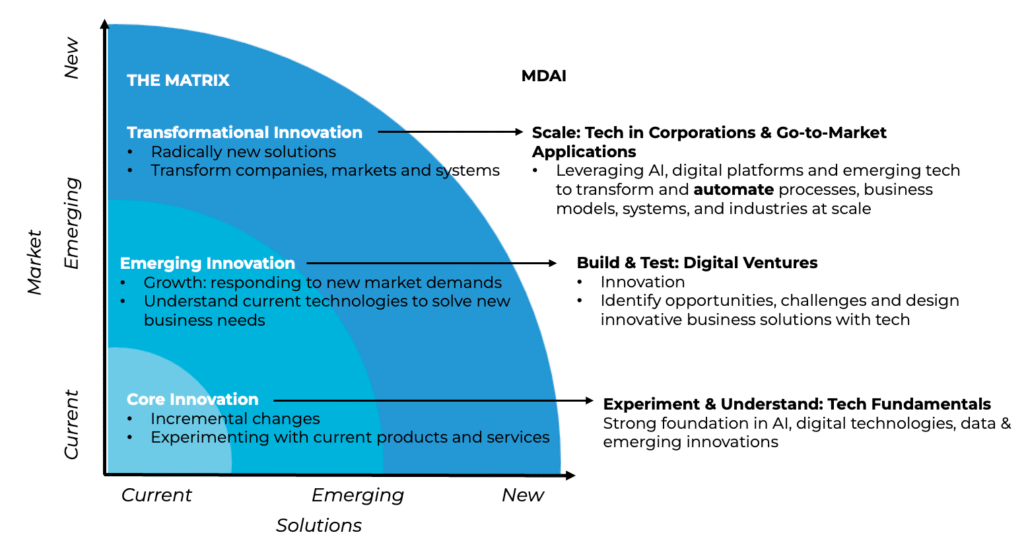
To bring this to life, I developed an innovation framework as the central pillar of the new narrative.
The framework was based on a simple idea: the way students learn should mirror the way digital innovation happens in the real world.
Students would move through the same progression they would later apply in their careers:
Understand → Build → Scale:
- UNDERSTAND: Build the foundations in AI, data, digital technologies and emerging innovation.
- BUILD: Use that knowledge to identify opportunities, solve problems and develop new products, ventures and digital solutions.
- SCALE: Apply technology across organizations to transform products, processes, customer experiences and decision-making—and turn innovation into sustainable business impact.
The New Narrative: Build to Scale
From this strategic framework, I developed Build to Scale as the new narrative for the program.
The concept captures the full journey from understanding technology to turning it into scalable business impact.
It reflects both the innovation process and the student’s professional development: as students progress through the program, they build the strategic, technological and leadership capabilities needed to lead digital transformation.
1. UNDERSTAND
Build the foundations to see what technology can make possible.
Students develop a strong foundation in AI, digital technologies, data and emerging innovations. They learn how these technologies work, where they create value and how organizations are already applying them across different functions.
2. BUILD
Turn technological possibilities into solutions.
Students apply their knowledge to identify opportunities, solve real-world challenges and develop innovative products, ventures and digital business models.
This is where the innovation mindset comes to life: experiment, test, validate and build.
3. SCALE
Turn innovation into organizational impact.
Students learn how organizations integrate AI, digital platforms, data and emerging technologies across functions—from product and customer experience to operations, marketing and strategic decision-making.
They also develop the leadership skills needed to connect technical and non-technical stakeholders, align priorities and drive adoption.
The role of AI
Throughout the narrative, AI acts as a companion to the journey.
It is not positioned as the destination or as a standalone specialization. Instead, students learn to understand it, experiment with it and apply it as a tool for innovation and transformation across different business contexts.
This reinforces the program’s core promise: developing professionals who understand technology deeply enough to transform business—and understand business deeply enough to unlock the value of technology.
The Result
Build to Scale transforms the curriculum into a story.
It gives prospective students a clear picture of where they start, how they develop and what they become: Understand technology. Build what’s possible. Scale what creates impact.
The result is a narrative that connects the program’s curriculum, innovation methodology, AI focus and business-school environment under one central idea—while reinforcing its positioning as a program for professionals who want to bridge business and technology and become the digital leaders of tomorrow.
The commercial target was surpassed by 130% with a 45% YoY growth in enrolled students. The funnel continues to grow compared to the previous intake.