I turn customer insights into growth strategies by combining CX, marketing and innovation.
I help companies launch, position and grow products by turning customer and market insights into actionable marketing strategies that drive commercial impact.
How I can help · Services
Let's review your marketing and innovation strategy, together.
Product Marketing Strategy
For companies or entrepreneurs interested in creating or redefining their marketing approach, this is a structured, end-to-end marketing strategy that will connect your products with the right audience.
Learn more
Product & Service Innovation
For companies or entrepreneurs interested in launching a new product or service: from problem exploration to a validated MVP, this is a structured process to turn opportunities into market-ready products.
Learn more
Innovation Workshops
Hands-on design-thinking sessions for corporate teams and academic programs that unlock new perspectives.
Learn more
Marketing Execution
I act as your execution partner, focusing on campaigns, content and cross-functional coordination, turning your strategy into results you can measure.
I'm a Product Marketing & Innovation professional with 7+ years of international experience across high-growth start-ups, digital agencies, and corporate environments. I specialize in bringing products and services to market, translating customer and market insights into strategies that strengthen positioning, accelerate growth, and drive commercial impact.
My background in Product Marketing, Marketing Management, Growth & Business Development, has given me a cross-functional perspective that connects customer needs, product value, and business objectives. Combining strategic thinking, analytical skills, and a customer-centric approach, I work across marketing strategy, digital channels, and customer experience to turn insights into meaningful solutions and measurable results.
I hold a Master in Customer Experience & Innovation from IE Business School, where I deepened my expertise in human-centered design, innovation, and creating experiences that deliver value for both customers and businesses.
Designing a Scalable Commercial System for a Tech Start-up
Role
Growth & Commercial Lead
Location
Cali, Colombia
Focus
CX · Sales · Process Design
The Challenge
Joining a high-growth, fast-paced digital startup to establish its first commercial structure. WACO Services is a digital agency offering digital marketing, branding, web, software development, and talent outsourcing — part of a broader company group including a co-working space and an innovation lab in Colombia.
When I joined, the company had a stable client base and a team of ~10 people.
The Project
Build scalable processes, align cross-functional teams, and design services that could grow with the company.
Research: Understanding the Ecosystem
I worked alongside the founder to develop the Commercial Department of the start-up, starting by understanding the services from every angle: team, market, and clients. These were the methodologies and insights:
The Market
Benchmarked digital agencies across Colombia and conducted interviews with professionals in the sector. Referrals were the primary growth channel. Clients were price-sensitive and needed to deeply understand the impact and value of the services. Trust and reliability were the key differentiators.
The Team
Interviewed every team to understand their process and needs in-depth. To create valuable work they needed better insights into the client's perspective, pain points and goals, which also increased engagement and ownership. The start-up was growing fast so processes had to be standardized, yet flexible and scalable.
The Clients
Clients valued simplicity; they wanted digital strategies explained in understandable terms and personalized proposals. Understanding each client's company stage was key: entrepreneurs needed fast go-to-market, corporates sought higher quality and structure. This would define the reach, timeline and pricing of the proposal.
Key Insight
Building trust was essential given scam-related concerns in the market. The best way to stand out was through reliability and demonstrable results, not just competitive pricing.
Designing the Process for Better CX
I co-designed a commercial and delivery framework that aligned internal processes with client experience.
Insight
Solution
Clients value personalized interactions
Structured the process including an initial call, briefing and presentation framework to properly assess their needs and present proposals with an in-depth explanation.
Clients value simplicity in technical communication
Worked with developers to translate technical concepts into client-friendly narratives focused on value and outcomes for software development and web services. For digital marketing projects, we went over how each solution would impact their marketing funnel.
Referrals were a key growth driver
Introduced kick-off meetings and touchpoints for transparency, plus formalized a Referral Program and Strategic Partnerships. Formal sales agreements were implemented, clear processes defined for accountability with partners and training sessions for "sellers" (referral partners) were created to equip them with a solid understanding of the services.
A scalable pricing framework was needed for a growing business
Created a "Mix & Match" modular pricing system for faster, more accurate quoting per client type and the mix of services required.
Process Innovation: The "Mix & Match" System
Clients often requested service combinations where simply adding hours didn't reflect true effort or value. I designed a modular pricing tool that transformed sales operations:
Combined core and variable modules based on project type
Maintained profit margins while adapting to client needs
Reduced proposal errors and increased perceived value
Differentiated pricing between entrepreneur and corporate clients
Driving Growth Through New Services: Launching Online Event Streaming
During the years of the COVID pandemic, online event streaming got more popular and we had the opportunity to provide them for key players in the city.
To continue diversifying and experimenting with digital experiences, I led the development of a new service line for providing online event streaming.
Two key projects that marked WACO's expansion into live digital production were:
Feria del Libro de Cali
One of the city's most recognized cultural events. Managed research, team expansion, partner collaboration, infrastructure and on-site coordination for multiple simultaneous streaming rooms.
Universidad del Valle Graduation
A major academic ceremony — won as a direct referral from the Feria del Libro success.
Building a new product narrative to differentiate an AI-driven program in a crowded market
Role
Product Marketing Specialist
Organization
IE Business School
Focus
Positioning · Narrative · GTM
The Challenge
A business-tech program in the portfolio was renamed to include AI, better reflecting its evolving curriculum and market relevance. However, the new name introduced a challenge: how could we clearly differentiate the program in an increasingly crowded AI and technology education market?
The Project
Developing a differentiated positioning strategy and narrative grounded in customer insights, competitive research and the program's unique combination of business, technology and innovation.
This project was developed during my role as Product Marketing Specialist at IE Business School — ranked #6 in the world by Forbes for the Best Business Schools List.
Research & Analysis
I started by understanding who the program was really designed for and where it sat within the competitive landscape.
Student & Talent Analysis
I analyzed data from previous cohorts to understand:
Students' academic and professional backgrounds
The balance between business and technical profiles
Their current roles and career trajectories
The skills and career paths the program was attracting
Competitive Benchmarking
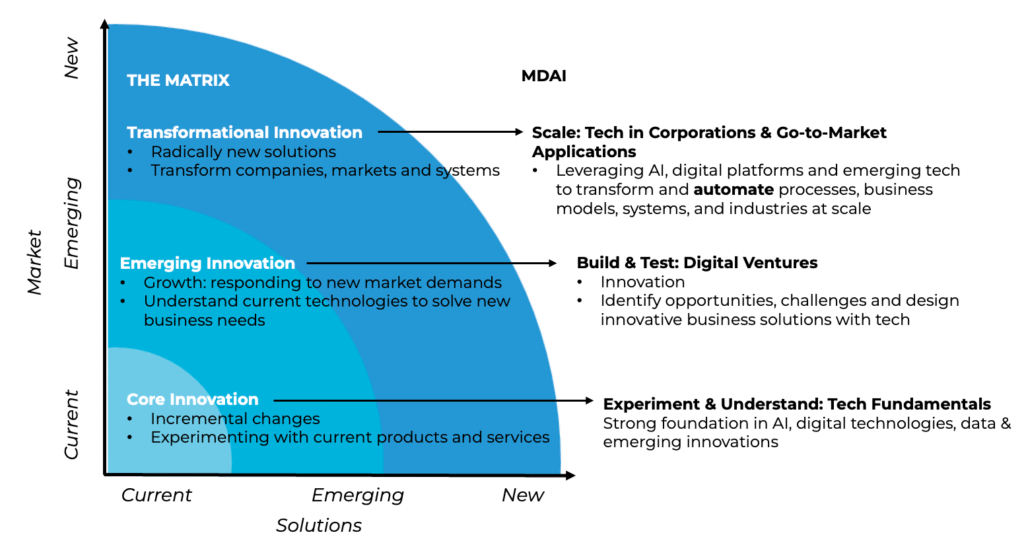
I mapped both external competitors and internal programs across key dimensions, including business/strategy orientation and technical intensity. I also analyzed competitor websites and messaging to understand:
How they positioned their programs
What they used as key differentiators
How they communicated AI and emerging technologies
Which language and value propositions dominated the category
Defining the Audience
The research revealed two main personas. One came from a business background, and the other from a technical one. Both shared the same ambition: to use technology to create greater business impact.
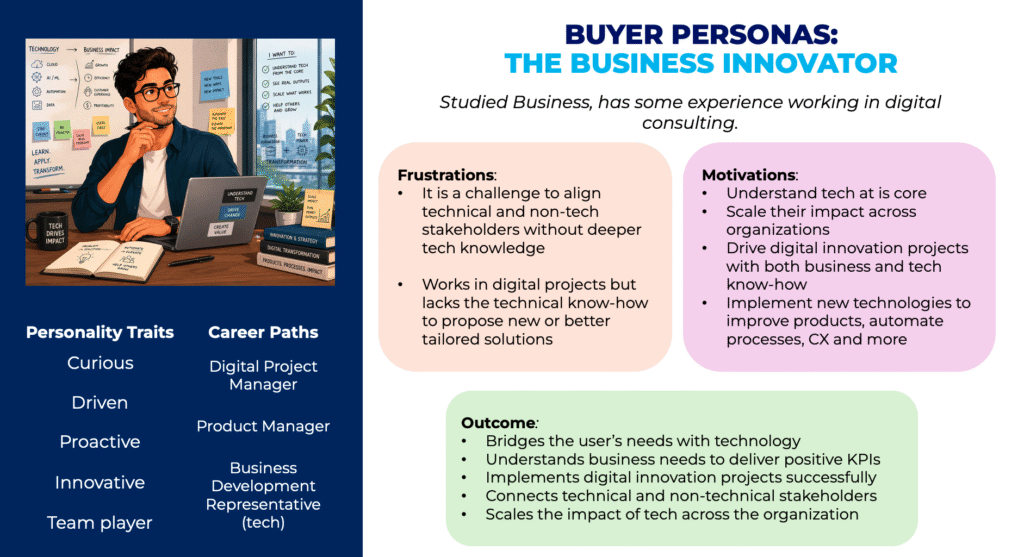
The Business Innovator
A business professional with experience in digital projects, looking to develop the technical understanding needed to turn ideas into better solutions. They want to understand technology at its core, lead digital innovation projects, and connect business needs with technical possibilities.
Transformation: From a business professional to a technology-enabled innovator.
The Techie
A technically trained professional looking to move beyond execution and understand the business context behind technical decisions. They want to progress into strategic roles and use their expertise to create greater organizational impact.
Transformation: From a technical expert to a strategic technology leader.
Key Insights
The research revealed three important opportunities:
1. The audience was hybrid
The majority came from business backgrounds but wanted to develop a deeper understanding of technology and its practical application. A smaller segment came from more technical backgrounds looking to expand their strategic capabilities.
2. The positioning needed to bridge both worlds
Competitor programs tended to lean heavily toward either business/strategy or technical depth. The opportunity was to position this program in the space between the two: strong strategic business foundations combined with meaningful technical intensity.
3. Innovation could become the connecting idea
Rather than presenting AI, technology and business as separate capabilities, I saw an opportunity to connect them through an innovation journey — using an innovation framework to showcase the curriculum and key learning areas.
Strategic Direction
The research revealed a clear positioning opportunity: the program needed to own the intersection of business strategy and technology.
Rather than competing as either a highly technical program or a traditional business master's, the positioning needed to show how students could understand technology, apply it to business challenges and ultimately use it to drive transformation.
I developed an innovation framework as the central pillar of the new narrative, based on a simple idea: the way students learn should mirror the way digital innovation happens in the real world.
Phase
Description
UNDERSTAND
Build the foundations in AI, data, digital technologies and emerging innovation.
BUILD
Use that knowledge to identify opportunities, solve problems and develop new products, ventures and digital solutions.
SCALE
Apply technology across organizations to transform products, processes, customer experiences and decision-making — turning innovation into sustainable business impact.
The New Narrative: Build to Scale
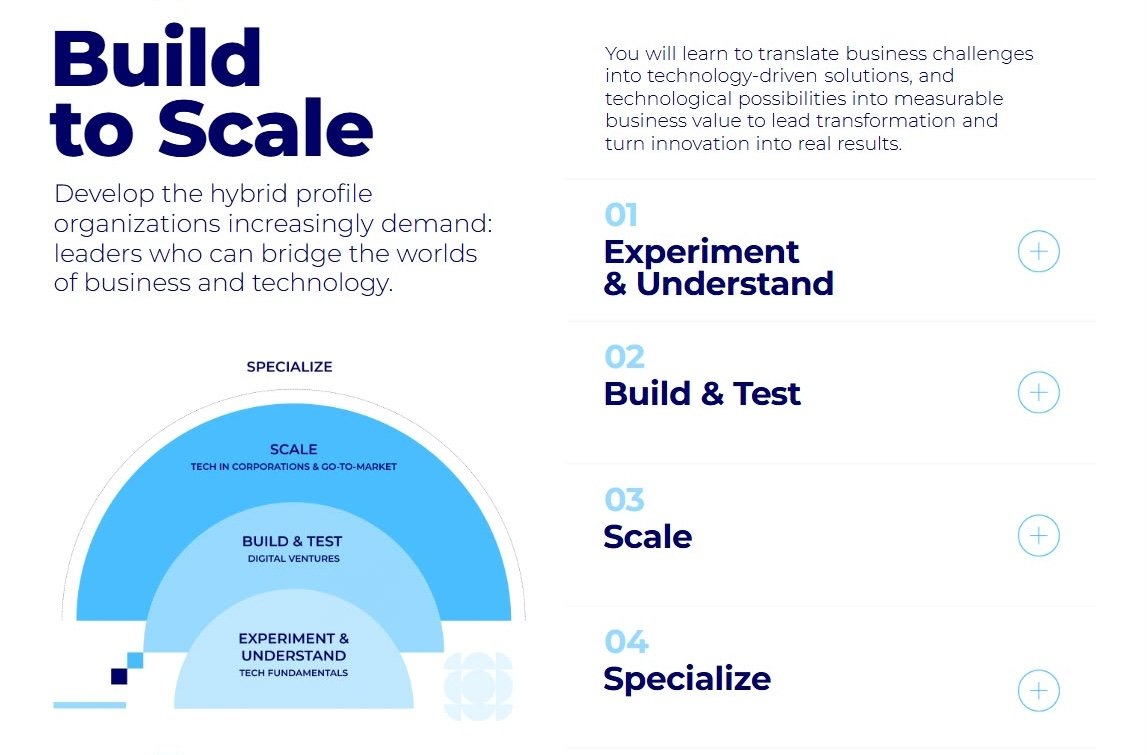
From this strategic framework, I developed Build to Scale as the new narrative. The concept captures the full journey from understanding technology to turning it into scalable business impact.
It reflects both the innovation process and the student's professional development: as students progress through the program, they build the strategic, technological and leadership capabilities needed to lead digital transformation.
1. UNDERSTAND
Build the foundations to see what technology can make possible. Students develop a strong foundation in AI, digital technologies, data and emerging innovations — learning how these technologies work, where they create value, and how organizations apply them.
2. BUILD
Turn technological possibilities into solutions. Students apply knowledge to identify opportunities, solve real-world challenges and develop innovative products, ventures and digital business models. This is where the innovation mindset comes to life: experiment, test, validate and build.
3. SCALE
Turn innovation into organizational impact. Students learn how organizations integrate AI, digital platforms and emerging technologies across functions — from product and CX to operations, marketing and strategic decision-making. They also develop the leadership skills to connect technical and non-technical stakeholders.
The role of AI
Throughout the narrative, AI acts as a tool which is part of the journey — not a destination or standalone specialization. Students learn to understand it, experiment with it and apply it as a tool for innovation and transformation across business contexts.
Results
Build to Scale transforms the curriculum into a story, giving prospective students a clear picture of where they start, how they develop and what they become.
THE CHALLENGE: To develop a comprehensive innovation portfolio for L'Oréal based on future forecasting for the industry, by developing incremental and radical innovation solutions.
L'Oréal is one of the leading beauty and personal care companies, growing at 2× the rate of the global beauty market with €32 billion in sales in 2021. The task: identify where the next wave of growth will come from — and build a portfolio of innovation projects to get there.
Finding Opportunities for Growth
By analyzing L'Oréal's financial statements and reports, we identified the following opportunities:
Haircare and skincare are the leading categories
Ecommerce has been the main driver of growth for 2 consecutive years, accounting for 29% of total sales as of 2021
USA, Latin America and North Asia are the regions driving the most growth
Most growth came from Professional Products (for beauty professionals and salons) and Active Cosmetics (chemical compounds that improve skin or hair)
Scientific innovation and research is a key competitive advantage — 4,000 scientists worldwide, €1.029 million invested in R&D
Industry Trends Aligned with L'Oréal's Opportunities
The macro trends reinforced the strategic direction:
Category Growth
Skincare is one of the biggest and most dynamic categories in beauty, followed by haircare — directly aligned with L'Oréal's strongest segments.
Channel Shift
Ecommerce has become one of the main channels in the industry, mirroring L'Oréal's own digital growth trajectory.
Personalization & Tech
Personalized services and products powered by tech and data are becoming a must — creating opportunities for AI-driven innovation.
Health & Sustainability
Health is becoming a priority in beauty, and providing sustainable products without exceeding planetary limits is a growing consumer concern.
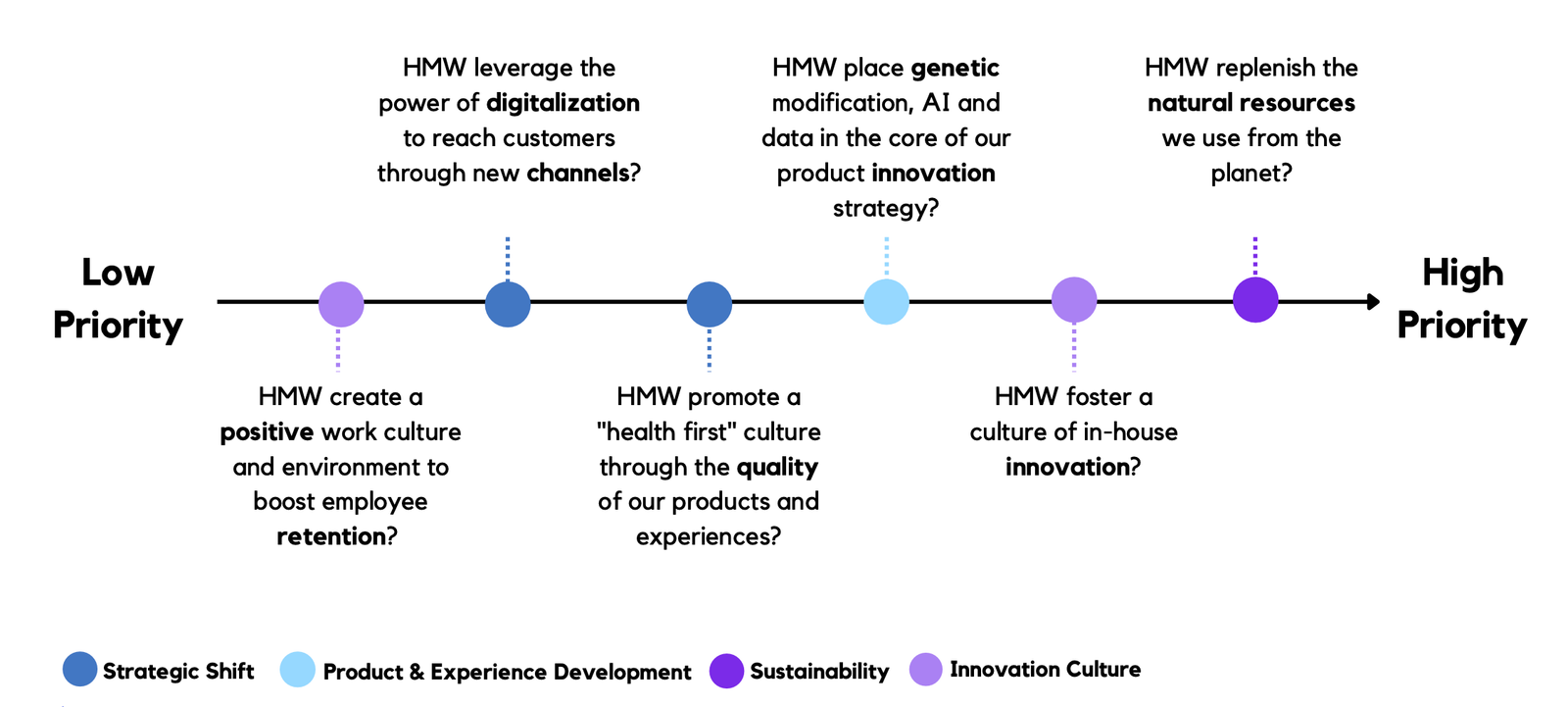
The Challenge Map
Taking into account current trends and growth opportunities, challenges to tackle were organized based on priority and impact. These include challenges for culture change and corporate innovation:
Innovation Portfolio
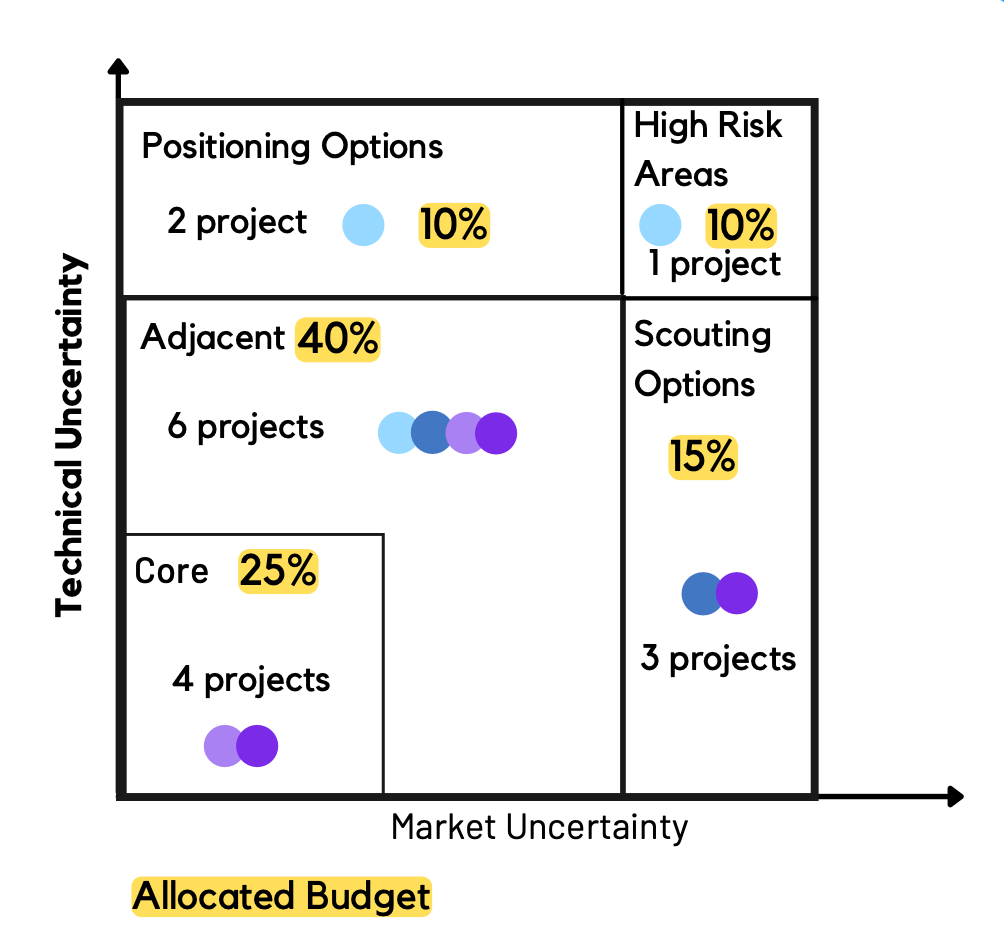
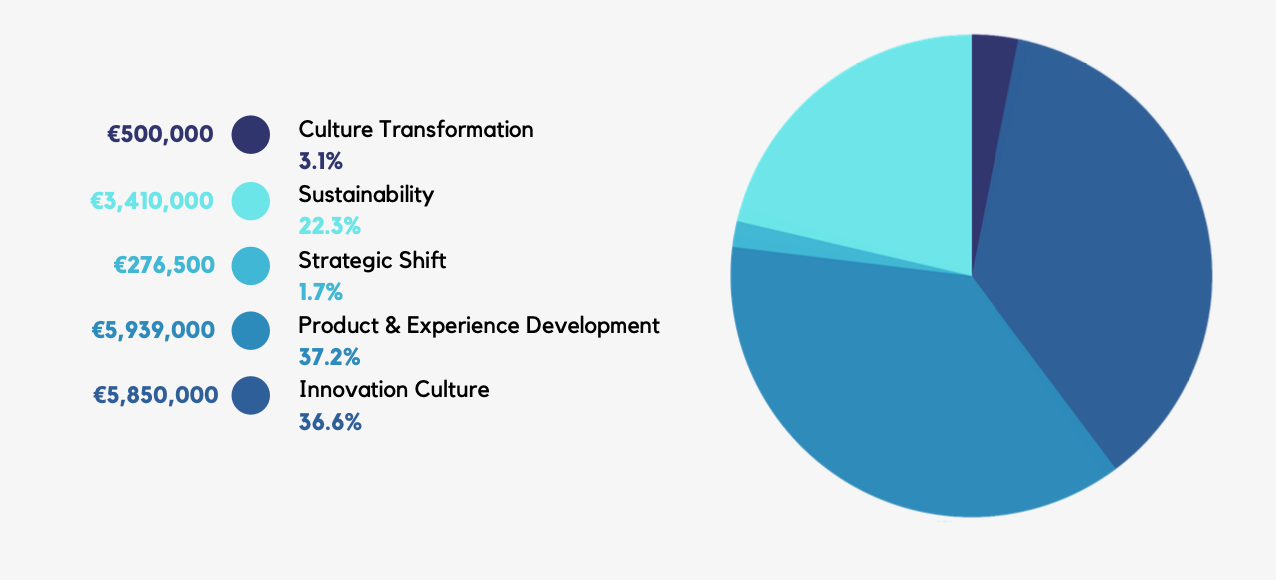
Through an ideation process informed by the challenge map, 16 innovation projects were evaluated and selected for L'Oréal's Innovation Portfolio. Projects were assessed based on the challenges they address, their expected impact, and their degree of technical and market uncertainty:
Each project was prioritized based on urgency, environmental and innovation/tech impact, and expected investment.
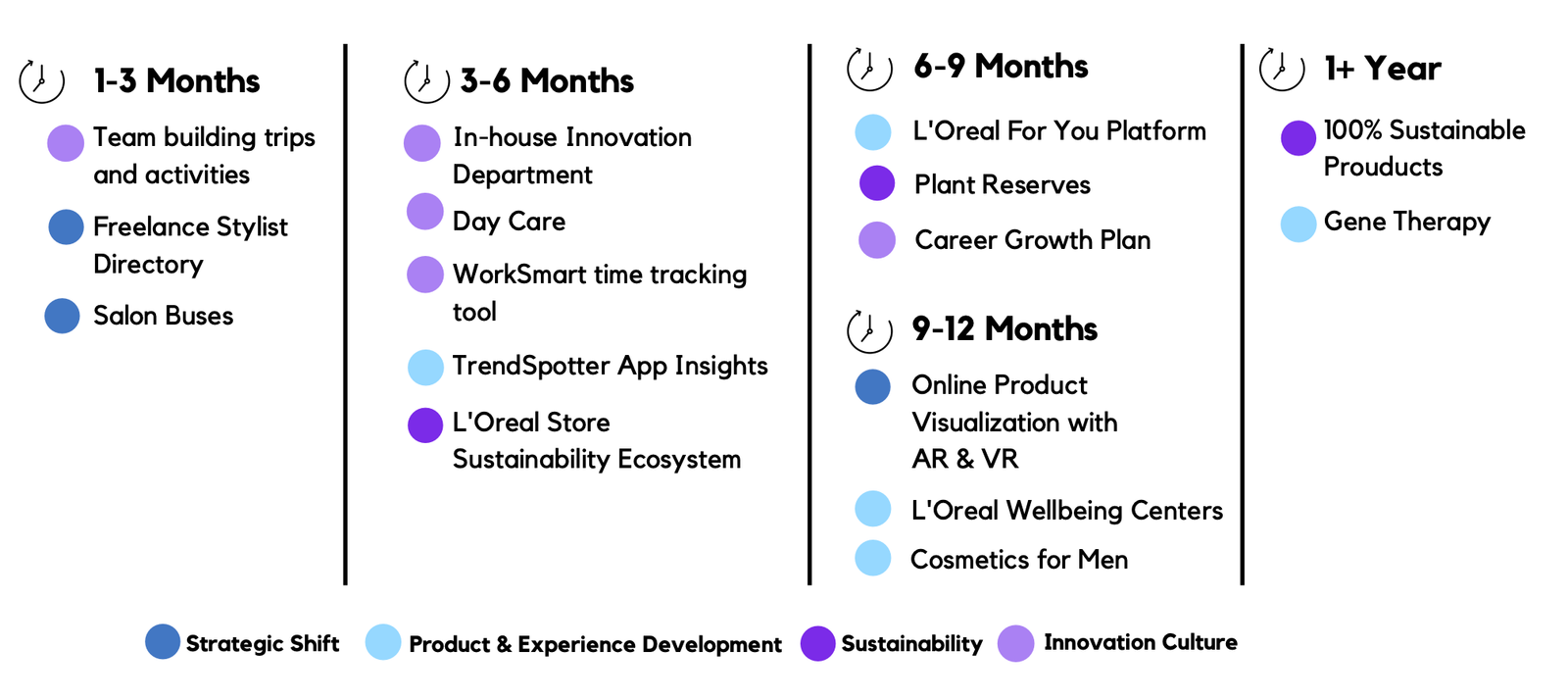
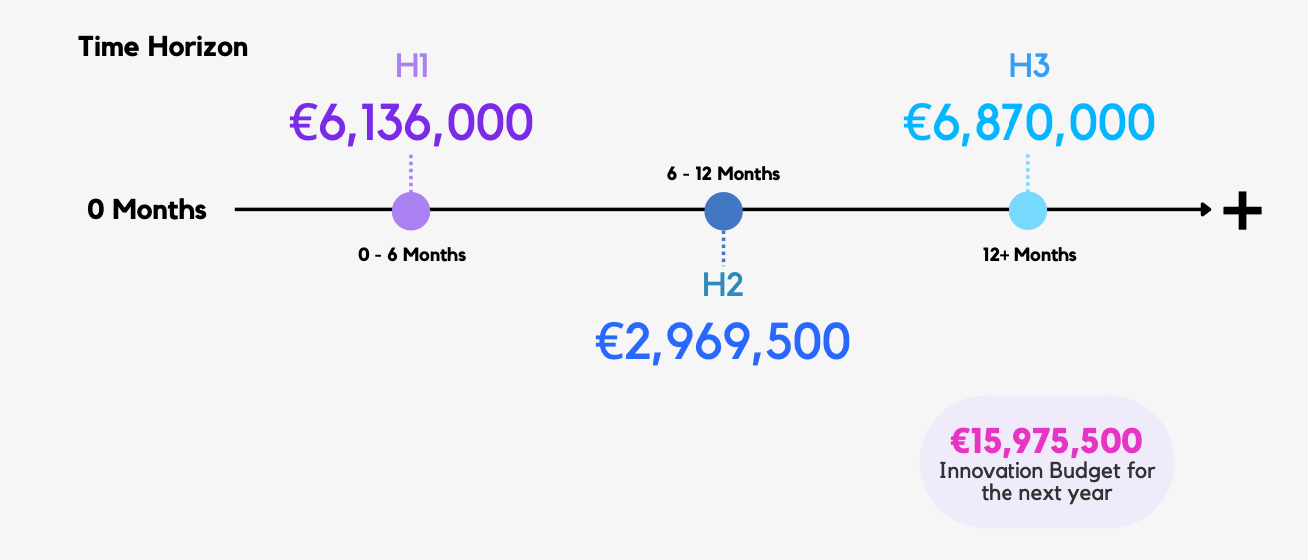
The implementation plan and budget for each project was assigned based on the factors evaluated above — impact (environmental, tech and innovation) and urgency.
Project Highlight: GENE4U
One of the most relevant projects in the portfolio — an online platform designed to use genetic analysis to create personalized beauty product recommendations. By partnering with DNA Genetic Testing companies, customers send their DNA sample and receive a specialized report about their beauty genetics and tailored product recommendations.
Today: Personalized Recommendations
An online platform that uses genetic analysis to match customers with beauty products based on their unique skin and hair DNA profile — transforming how L'Oréal delivers personalization at scale.
The Future: Gene Therapy
Looking at a longer time horizon, investment in research for gene therapy sessions that could enable customers to permanently change aspects of their skin and hair characteristics — a radical innovation bet on the frontier of beauty science.
Key Takeaways
Balance incremental and radical
A healthy innovation portfolio needs both safe, near-term bets and high-risk, high-reward moonshots. The challenge map helped L'Oréal see where to place each type of investment based on urgency and strategic fit.
Trends as validation, not just inspiration
Aligning innovation projects with both internal growth data and external industry trends created a stronger business case for each initiative — making it easier to secure internal buy-in and prioritize resources.
How might we advance in digitalization without leaving anyone behind?
Role
CX & Innovation Consultant
Client
Santander × IBM
Focus
Design Thinking · Prototyping · User Research
The Challenge
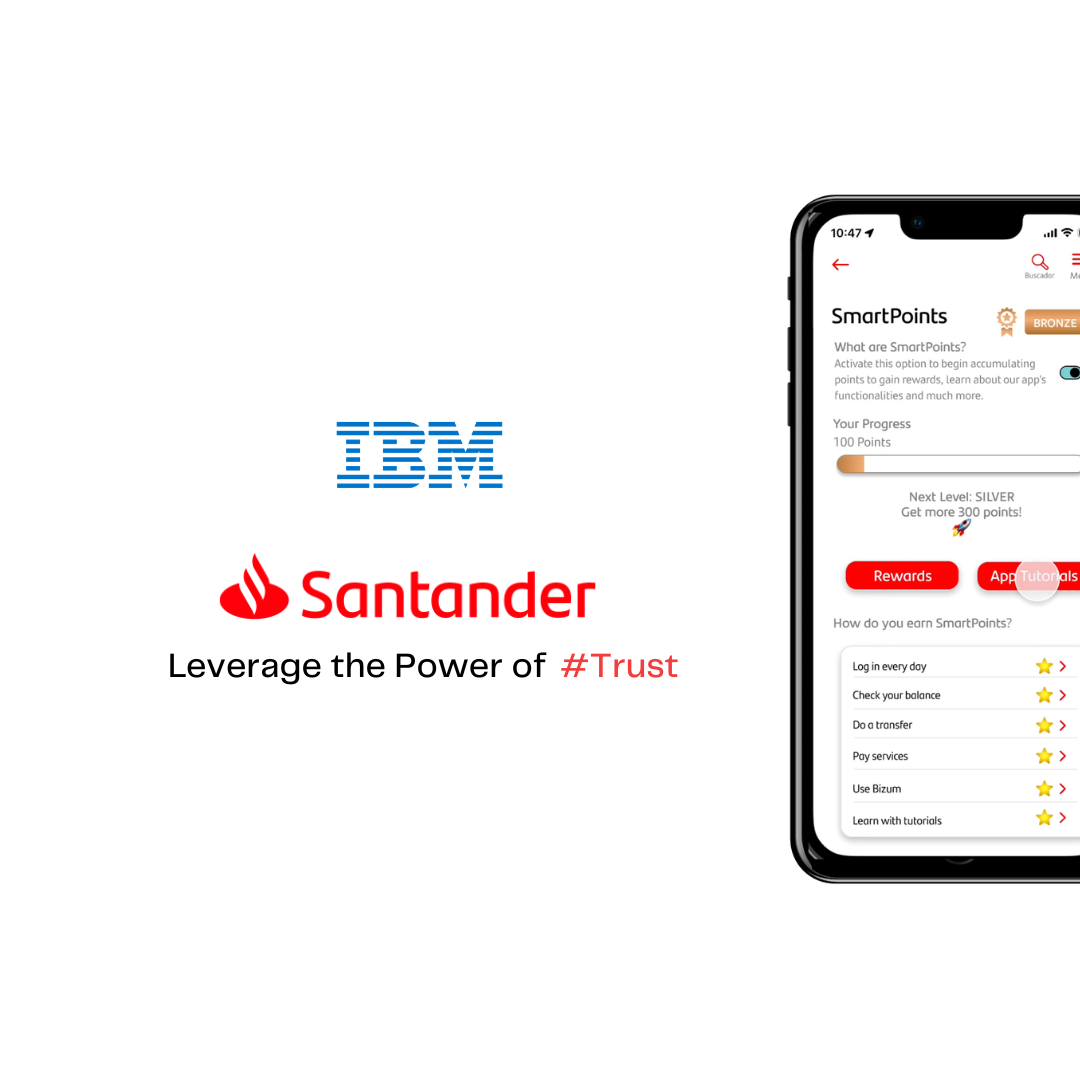
Santander is one of the leading and most renowned banks in Spain. With more than a century of experience in banking, Santander sought to implement digital innovation in their services in collaboration with IBM.
The central question: How might we advance in digitalization without leaving anyone behind? The goal was ensuring that all generations, especially those less comfortable with technology, could benefit from digital banking services.
Research
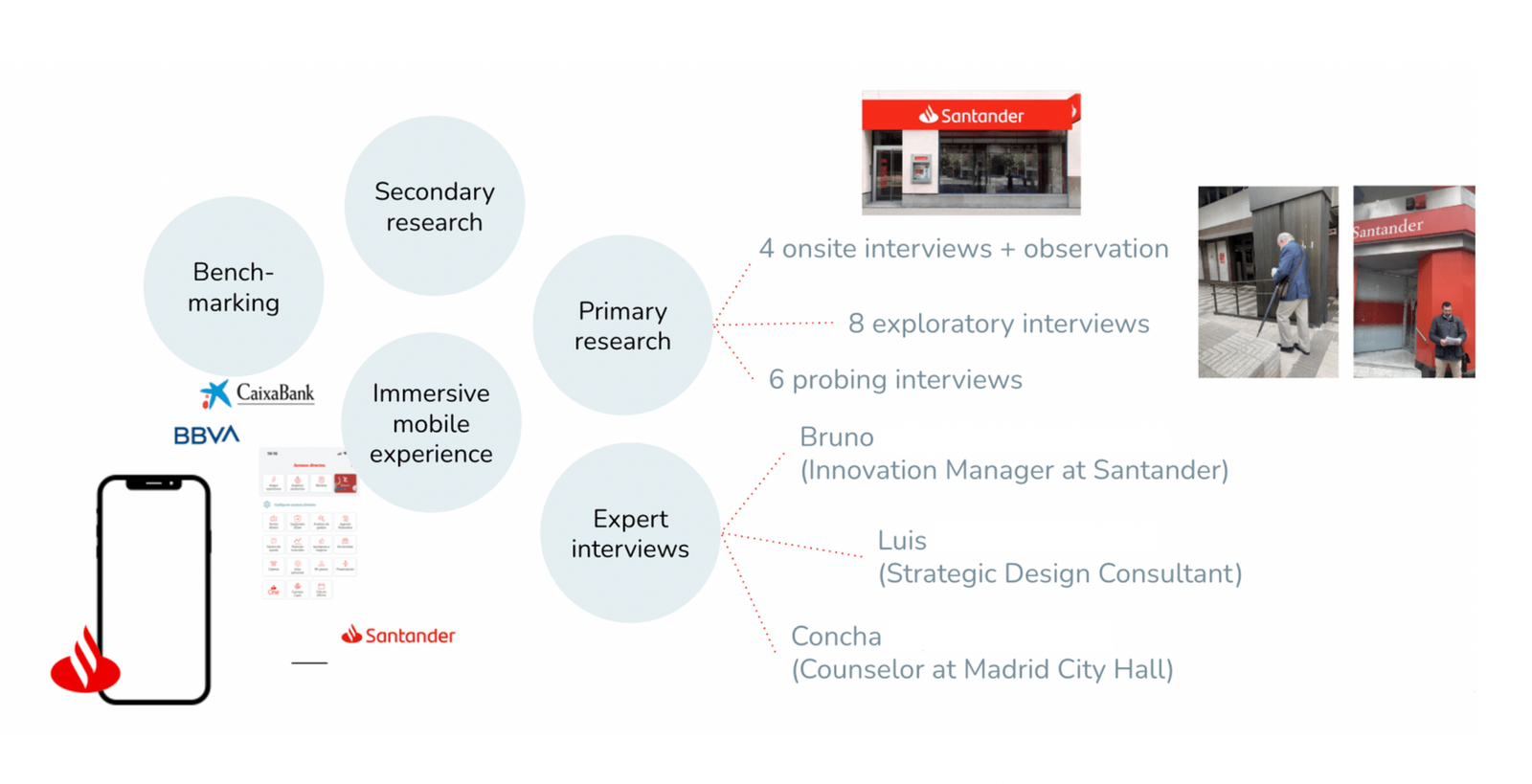
The first approach was understanding the perspectives on digital banking from different generations and the experience Santander offers to its clients. This was done through:
Competitive benchmarking of digital banking experiences
Immersive mobile experience testing
Exploratory and probing interviews with Santander users
Expert interviews with banking professionals
Secondary research on digital adoption patterns
Persona Development
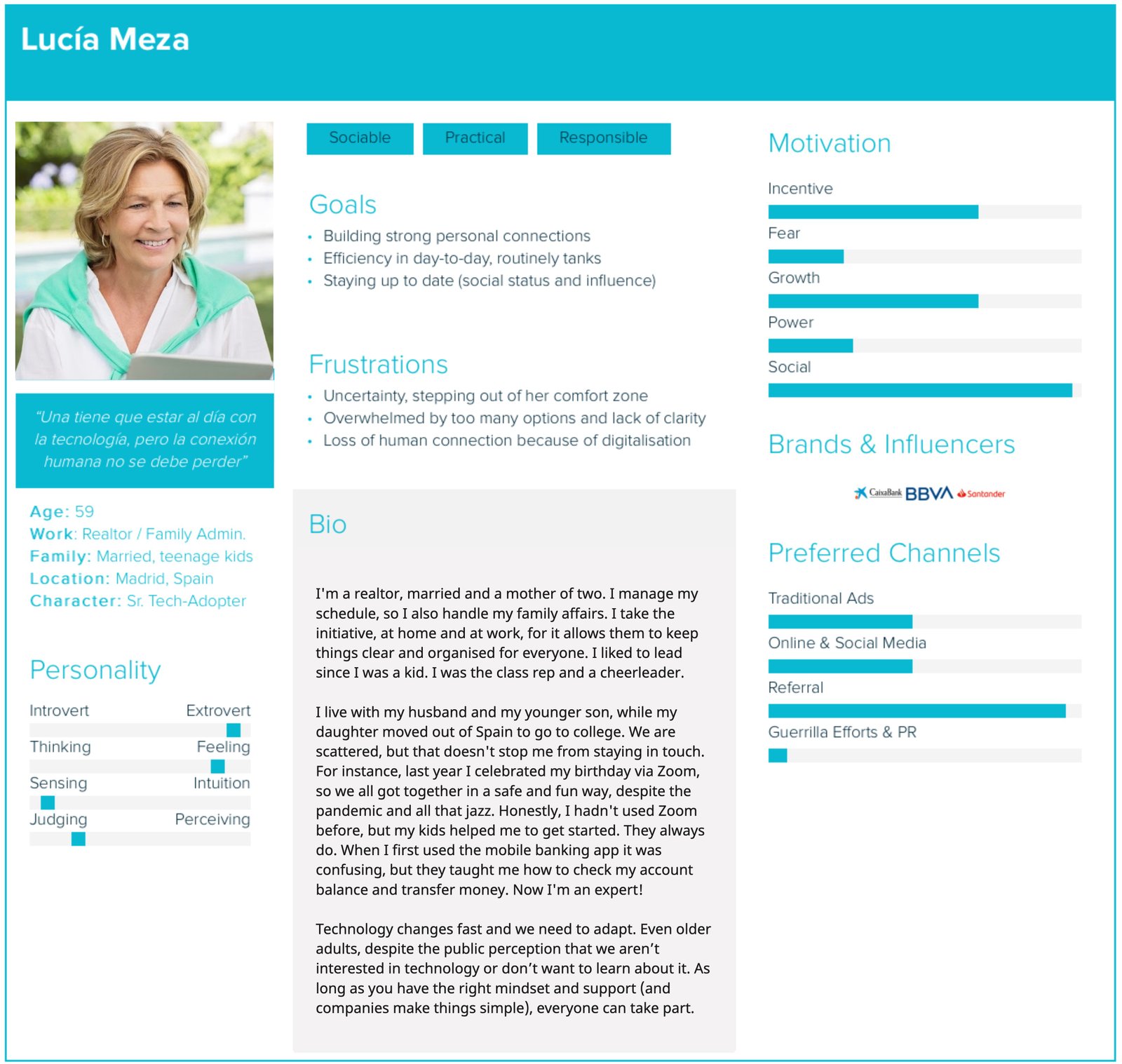
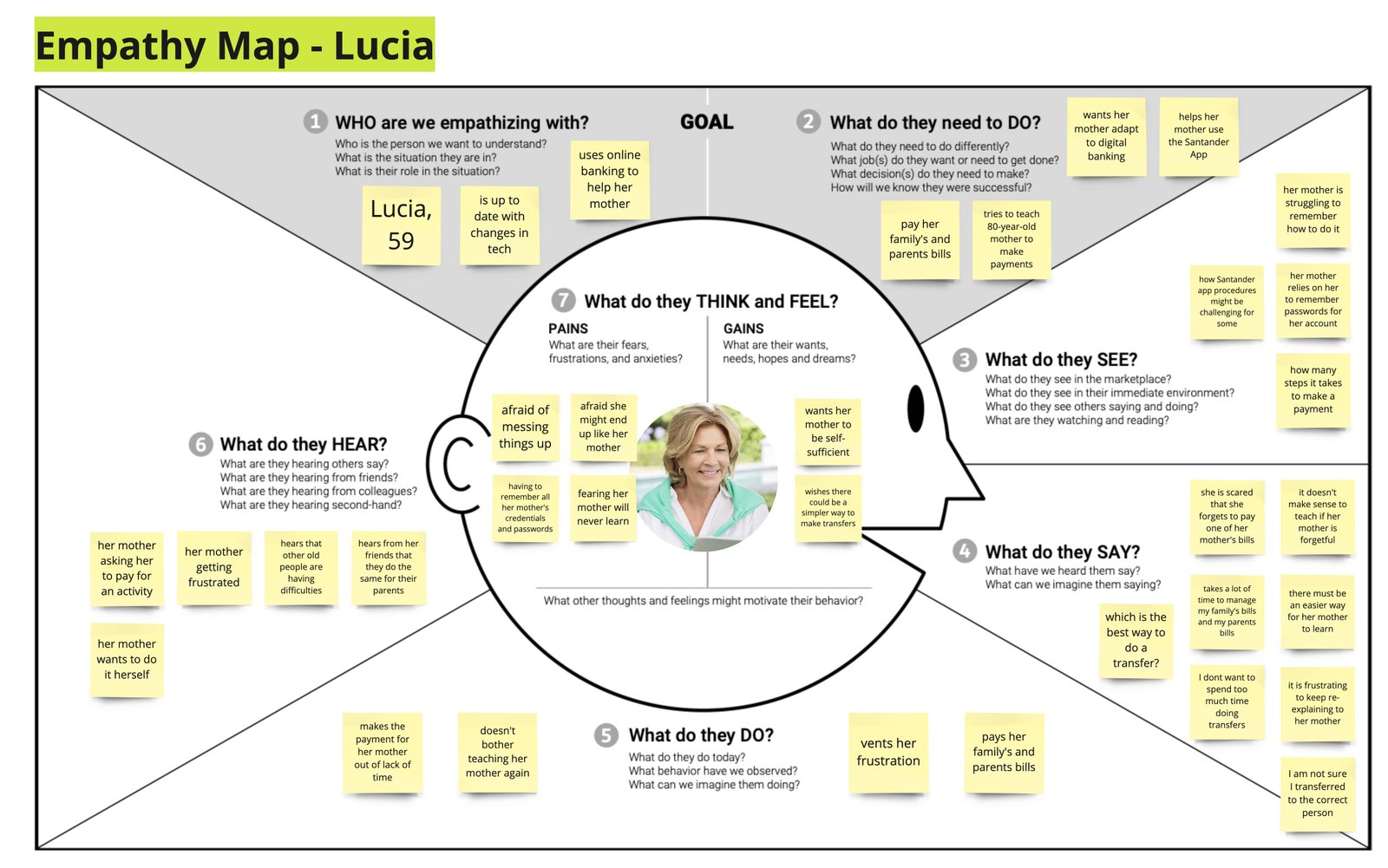
The persona was based on a 59-year-old woman, Lucía, who acts as the core of her family. She manages finances for her parents and children, using the banking app to facilitate these transactions.
She is a frequent user with the need to be up to date and help those around her. However, it is challenging to keep up doing transactions for her parents and explaining how the app works to them.
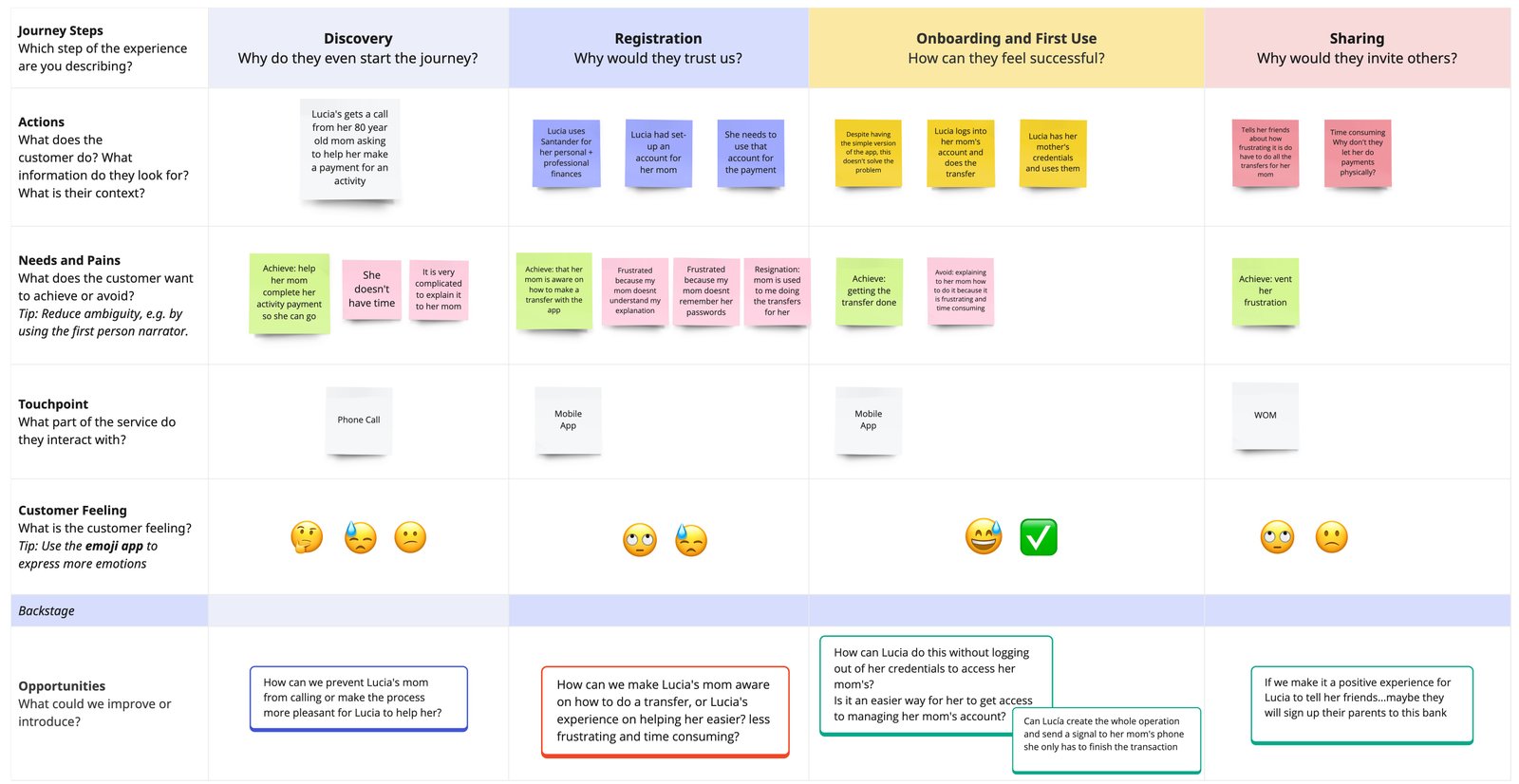
Customer Journeys
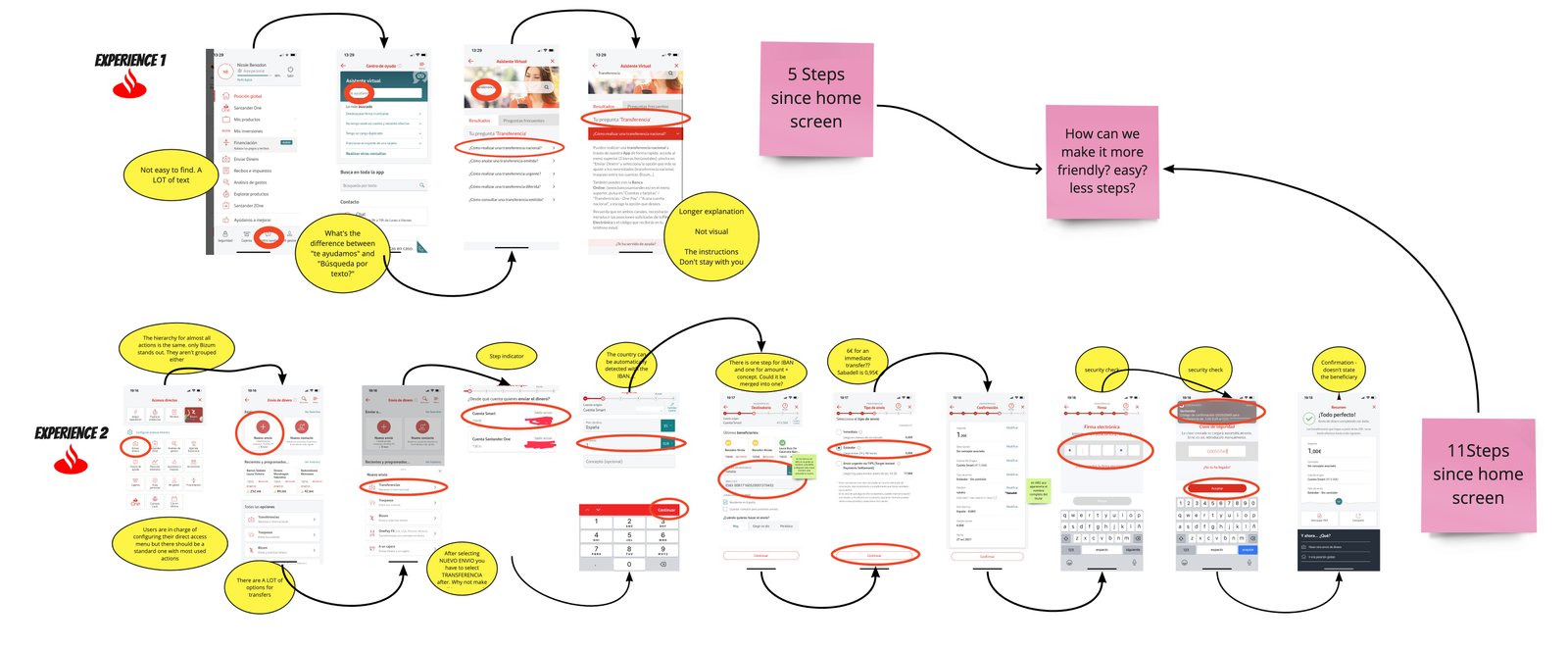
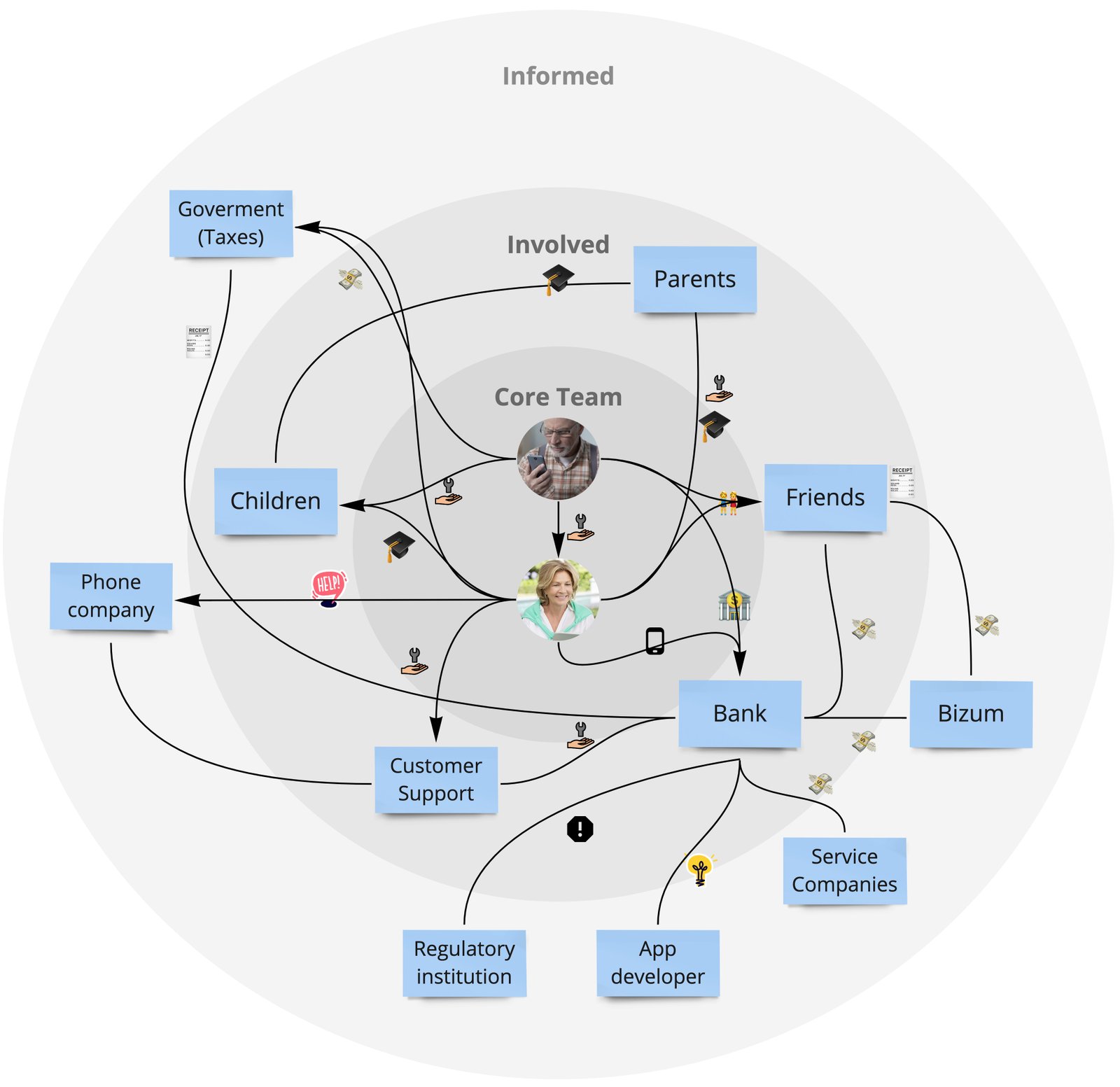
Customer journeys were built to understand each of Lucía's interactions: doing transactions for her parents and her own day-to-day transactions, finding the main pain points for each scenario.
Key Insights
Based on the customer journeys and research, we identified three core insight areas:
Security
Most users feel they can't trust digital platforms as they usually receive texts or calls from unverified numbers. They feel the need to double-check every transaction done online because they are afraid to make a mistake.
Perceived Ability
Regardless of their age, users feel they don't need help to use the app but think older people do. Adults have opposite reactions when it comes to handling technology: they feel either shame or pride in their knowledge.
Connectedness
Digital banking is used to care for their family's needs for both parents and children.
Ideation & Prototyping
By focusing on the main insights — security, perceived ability and connectedness — we created an idea portfolio, prototyped and tested solutions for each area. Surveys, wireframes and interviews were all part of the process before reaching the final prototype.
Solutions
A solution was created for each insight area, designed to integrate seamlessly into Santander's existing digital ecosystem.
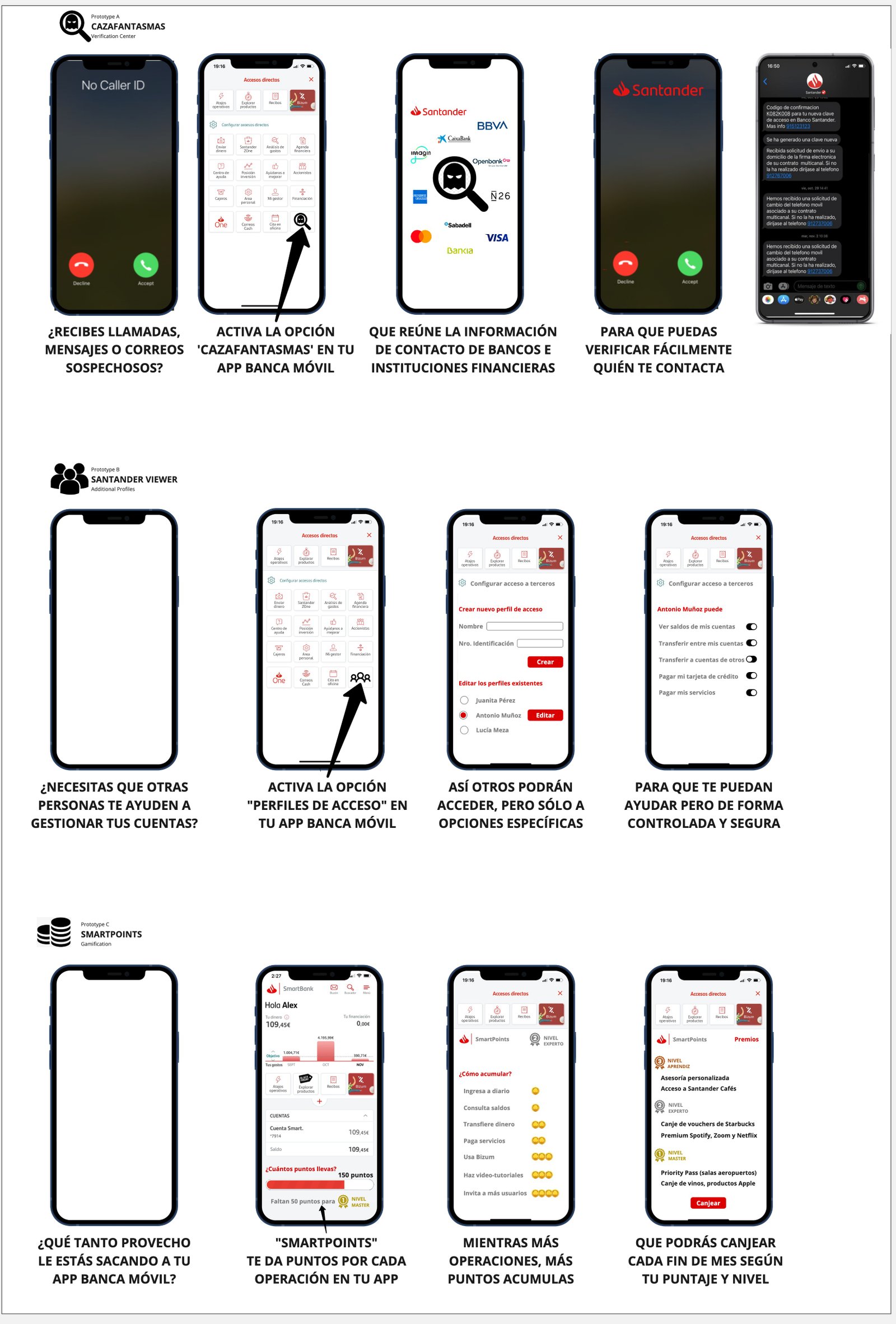
Verification Center
Trusting Santander's digital touch points to break the barrier of fear
Instant identification and verification of all Santander communications. Helps users differentiate real messages from scams, increasing trust and security in digital channels.
SmartPoints
Empowering users to stay up to date in a dynamic and didactic way
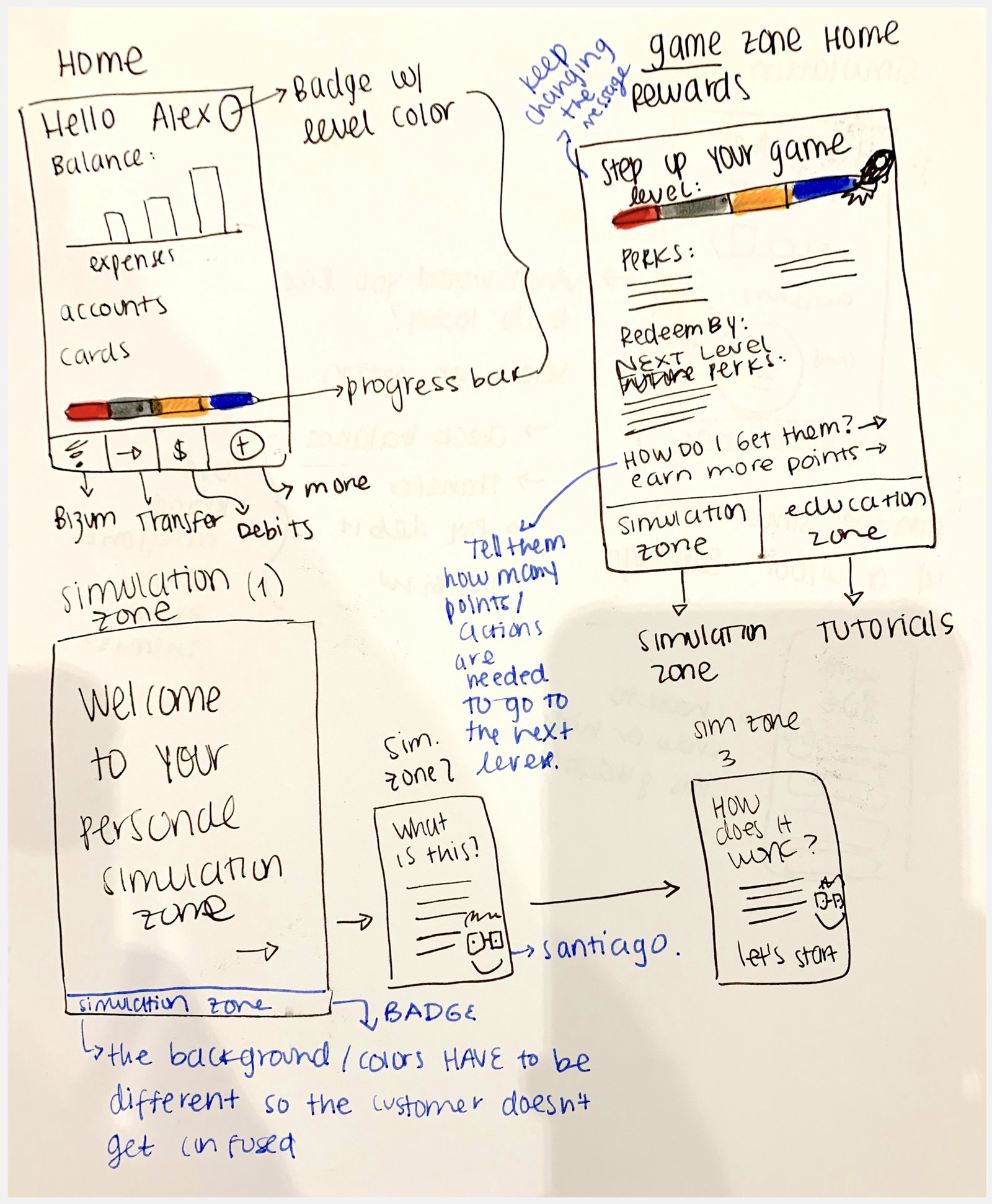
Fun learning and onboarding through gamification. Raises awareness of new functionalities and rewards users for adopting digital channels, making them feel capable and in control.
Connect Hub
Helping and getting help has never been easier and safer
A hub for facilitating transactions within a close circle: those selected by the user can perform transactions on their behalf. Connecting families, trusted friends and those you care about — turning the banking app into a tool for care, not just commerce.
Prototypes in Action
Verification Center
SmartPoints
Connect Hub
Key Takeaways
Users like feeling in control
Users didn't consider that they didn't know how to use the technology, but would usually mention someone older than them needed their help. When designing solutions, it was key to make them feel knowledgeable and in control, but with an opportunity for improvement.
Digitalization is about connection
Banking solutions should not only help each user solve their own problems, but they should help them solve their family's and close friends' problems too. Digital solutions should leverage these connections, which not only help the customer but increase the number of users and valuable data.
*Project developed during the Master in Customer Experience & Innovation at IE Business School.*
How might we increase the number of beneficiaries to significantly scale social impact through digital skills?
Role
Service & Innovation Designer
Partners
Power.Coders × Impact Hub
Focus
Design Thinking · Social Innovation · Systems Design
The Challenge
THE CHALLENGE: How might we increase 10× the number of beneficiaries of Power.Coders in Spain in order to significantly increase their impact?
Power.Coders is a project that empowers refugees by teaching them digital skills. Through bootcamps and courses, refugees in Switzerland, Spain and Italy learn coding skills to enter a growing labor market. They were recently launching the program in Spain in collaboration with Impact Hub and were looking for solutions to increase their impact.
The Starting Point: Defining Impact
Impact, in the context of Power.Coders, means increasing the percentage of refugees that complete their bootcamps and integrate into the workforce.
93%
of graduates find an internship after the bootcamp
60%
find a job after completing the bootcamp
Research
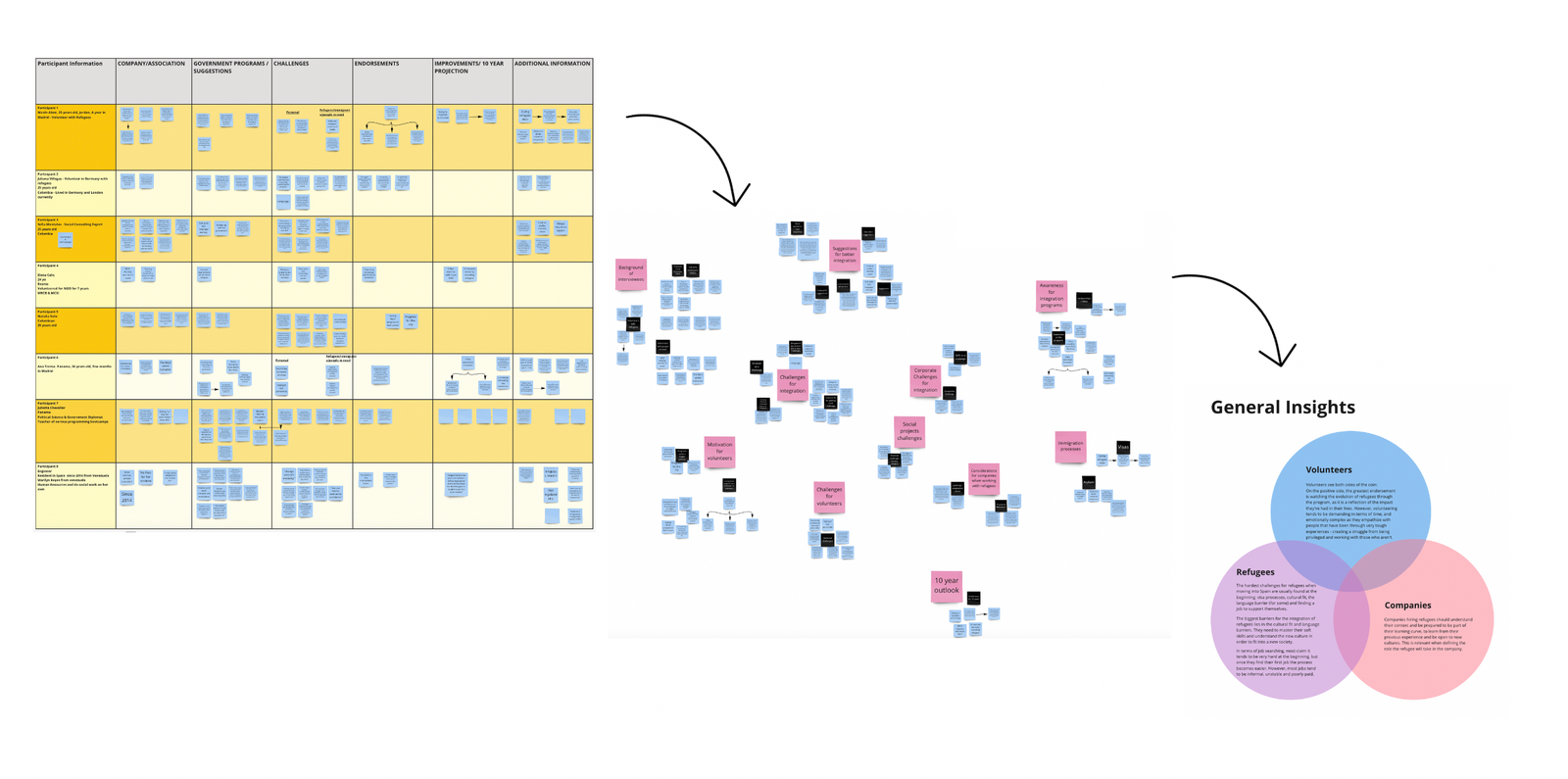
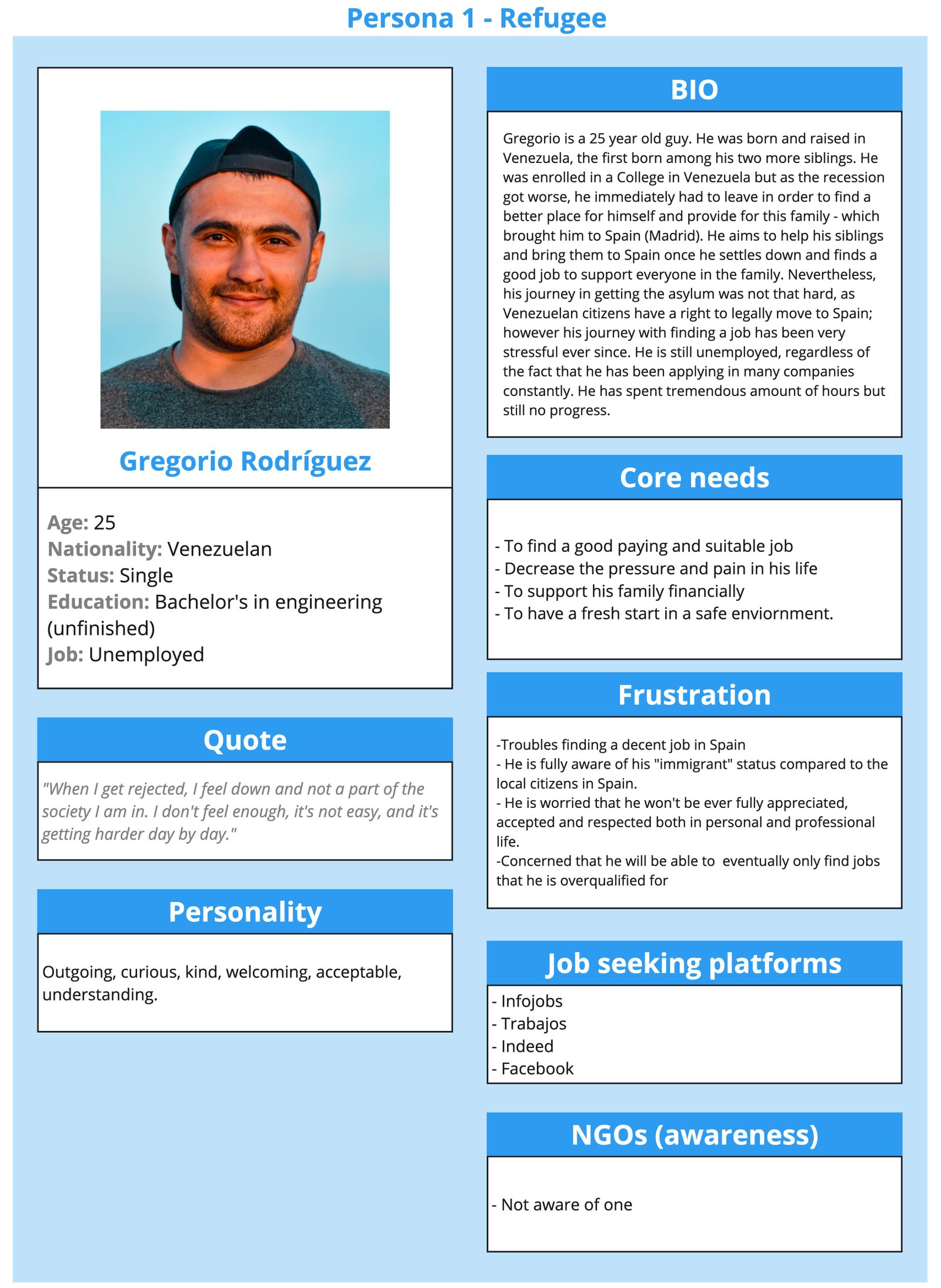
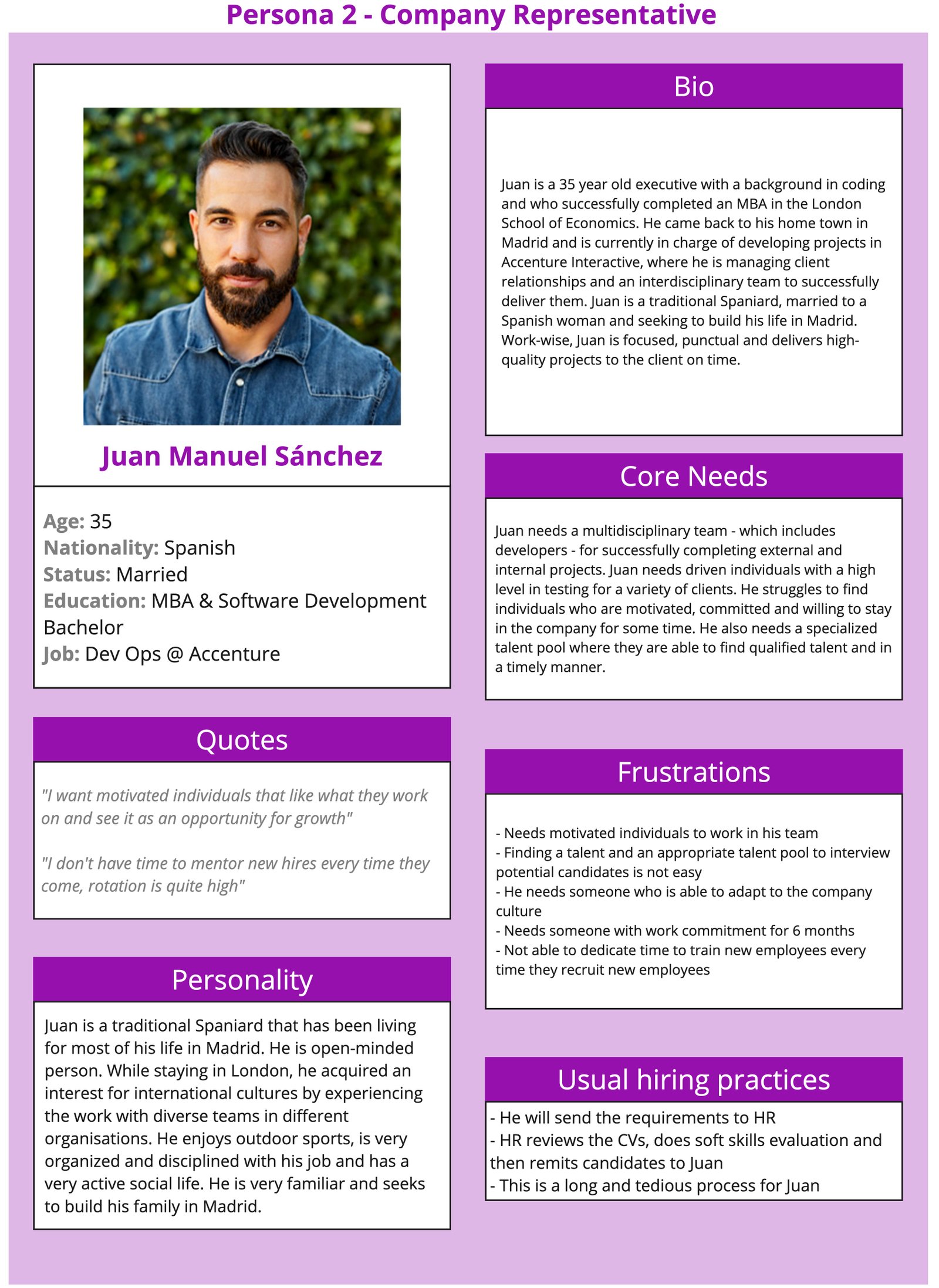
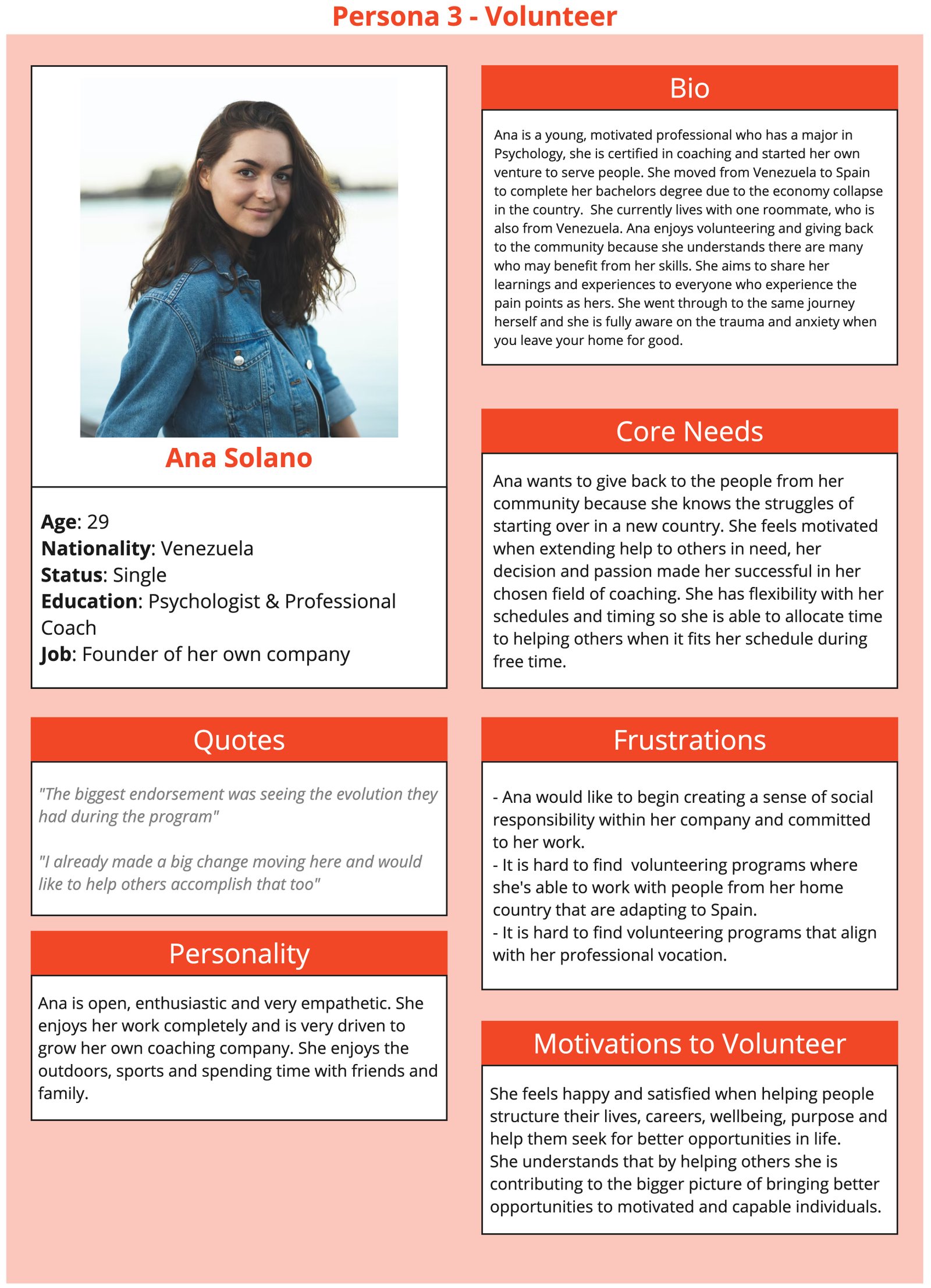
By interviewing experts in technology, social impact projects, refugees in Madrid and volunteers, we identified three pillars in the ecosystem: Refugees, Volunteers and Companies.
Through secondary research, interviews and observations on the refugee situation in Spain, their integration process and the coding sector, we gathered insights from both the individual and the system's perspective.
Persona Development
Understanding the objectives of each persona was critical to design a solution portfolio that would motivate and include each player at the right step. This was done through empathy maps, ecosystem maps and the Jobs to be Done framework. The main personas included:
Refugees — the primary beneficiaries
Company representatives — potential employers
Volunteers — mentors and coaches
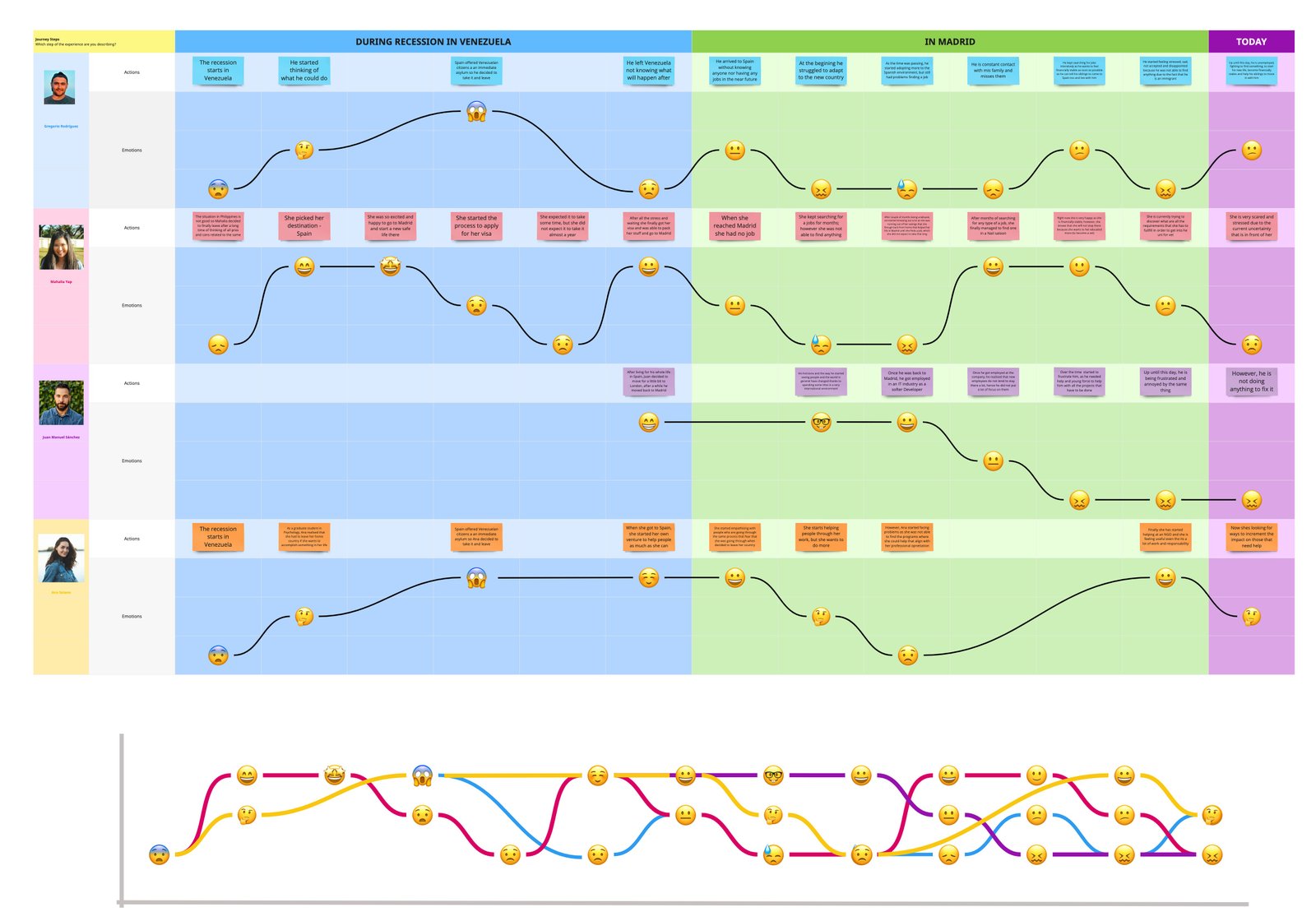
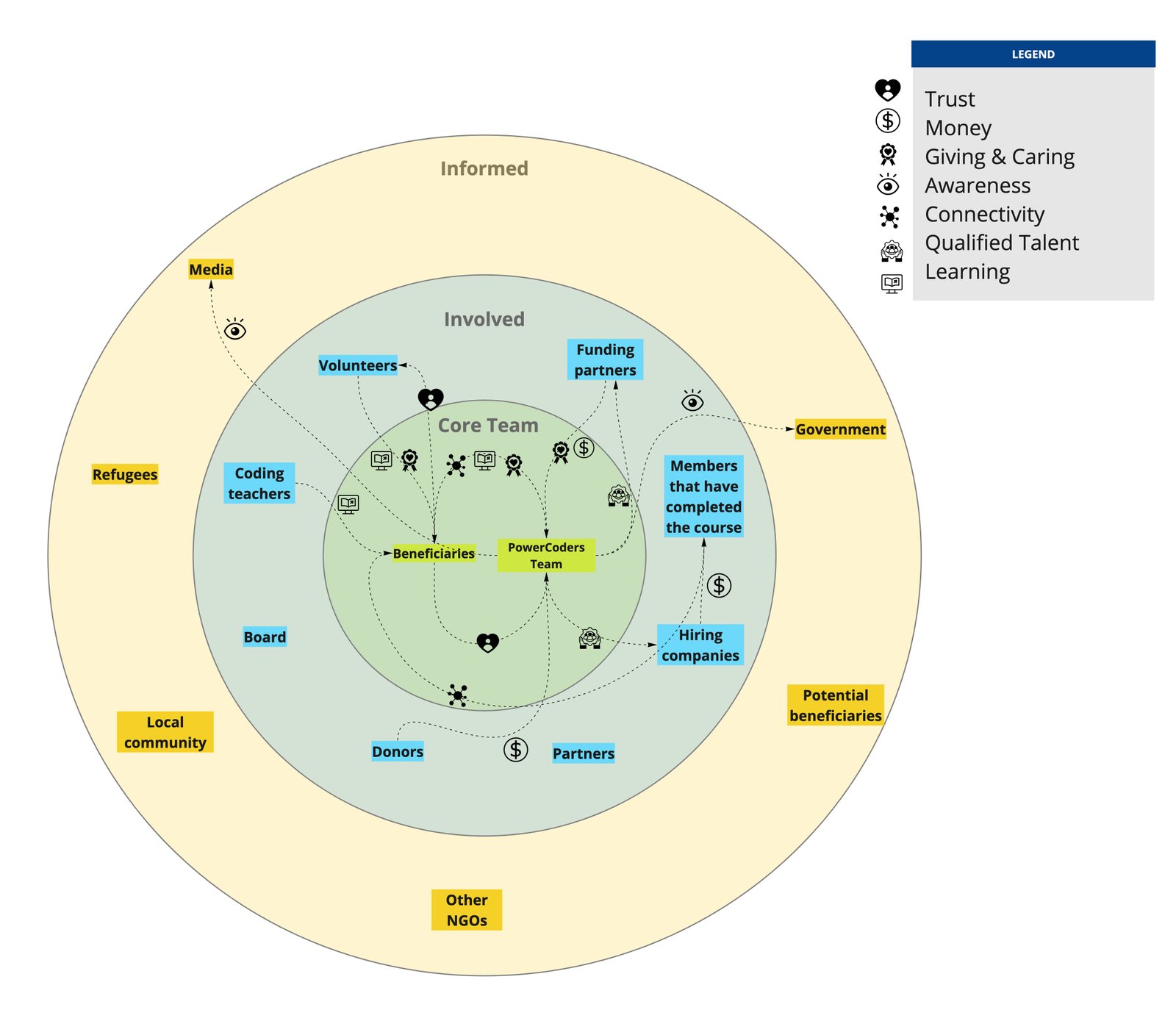
Ecosystem Map & Empathy Map for Refugees
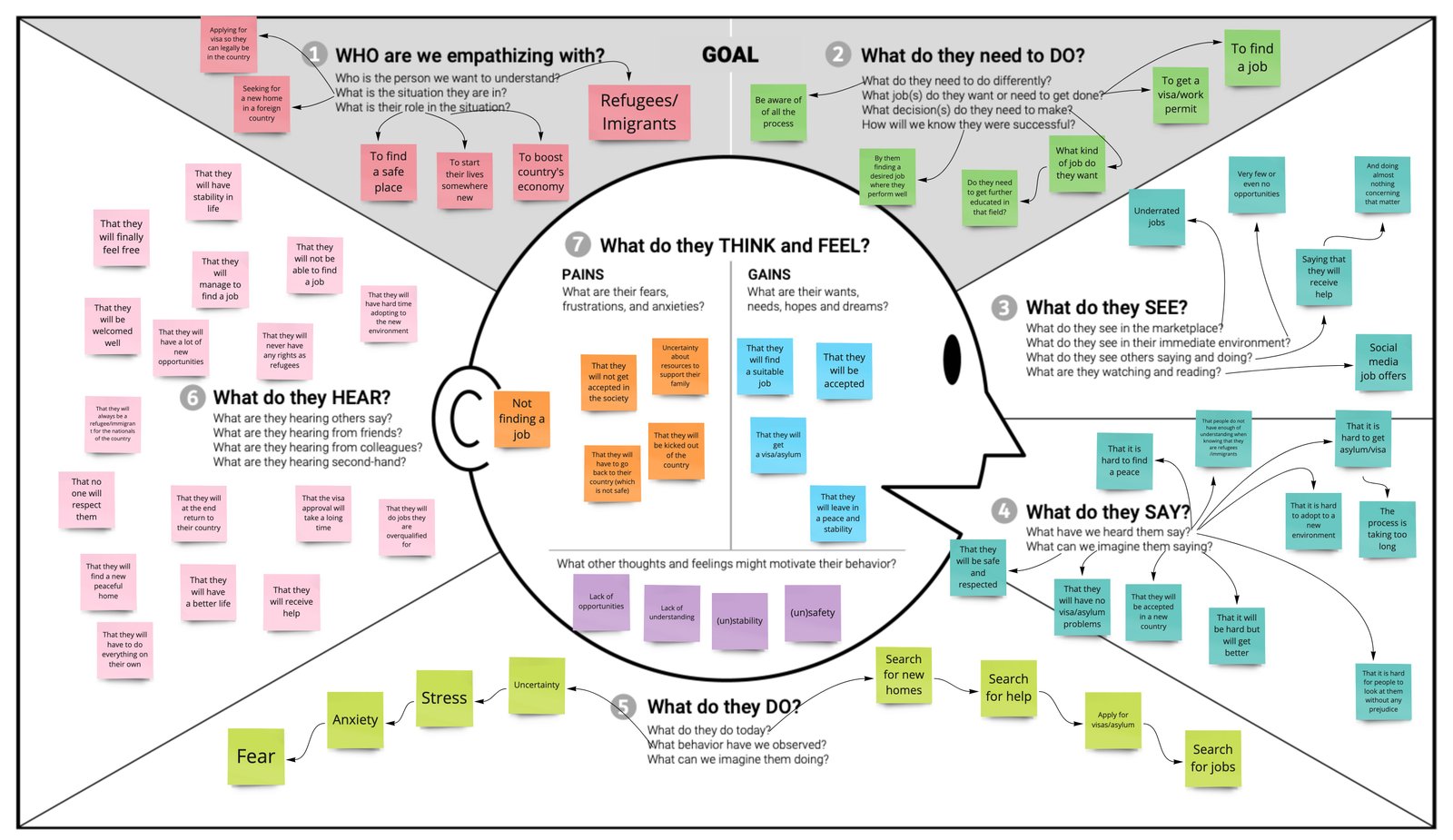
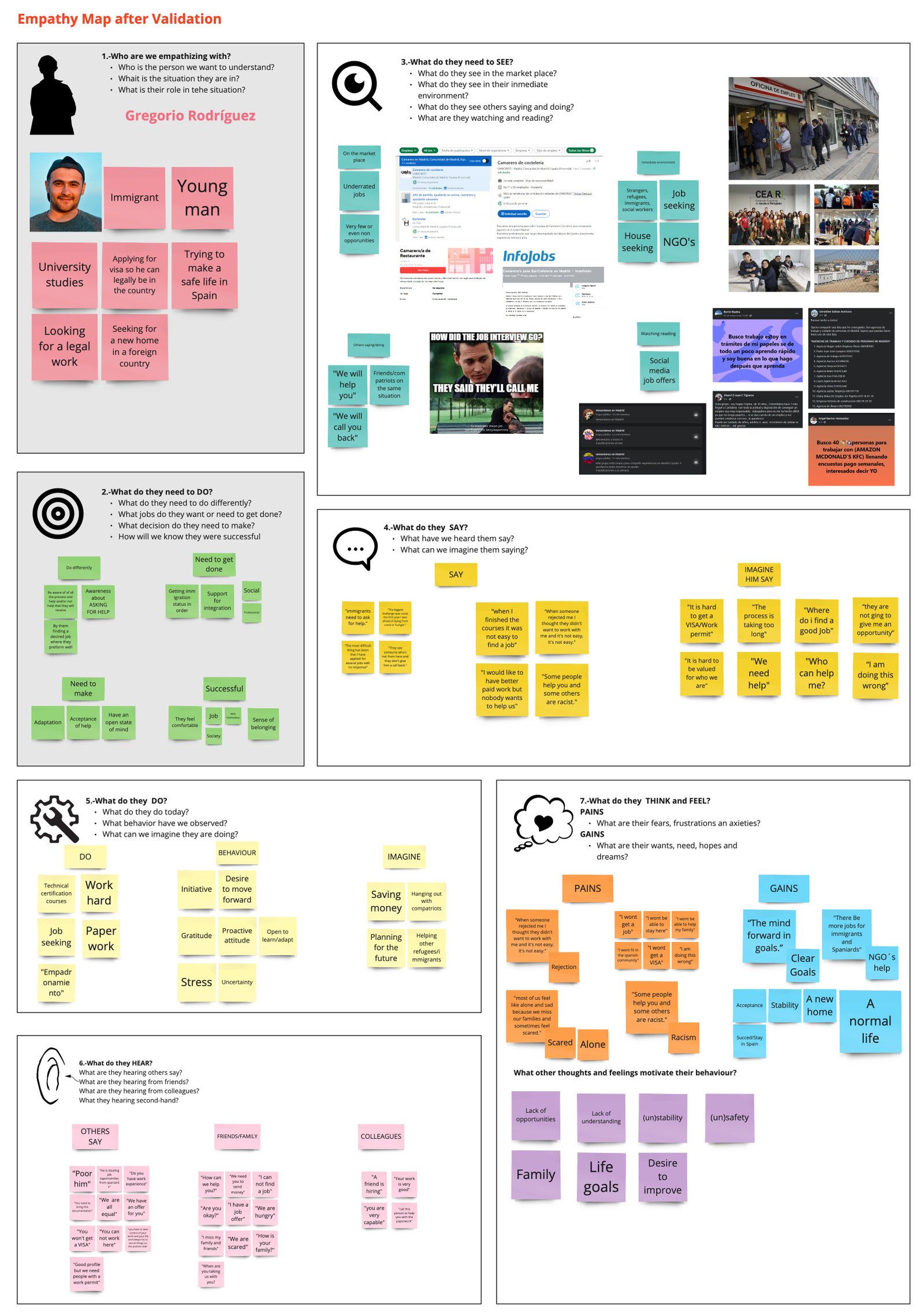
Most transactions correspond to interactions beyond the material world, such as trust, caring, giving and networking opportunities. We built an empathy map based on our own assumptions and then a validated one through interviews:
Key Insights
1. Funding dependency
Bootcamps are financed only by donations — there are no other income sources, making growth directly dependent on fundraising.
2. Volunteer burnout
Volunteers are happy to help and see the progress of the refugees, but participating in the program is emotionally demanding too.
3. The hardest part is starting
For refugees, the biggest barriers are at the beginning: visa processes, cultural barriers, language barriers and the job search process.
4. Awareness gap
Companies need more awareness on the value internationals bring, and on understanding their learning curve and context.
5. Talent discovery challenge
For HR specialists, finding the right talent in tech is challenging — these profiles are part of niche communities not easily found on traditional platforms like LinkedIn.
Pillars for Growth & Impact
To increase impact by 10×, the systems that create impact needed to grow — alongside greater financial independence.
What do we need to increase impact by 10×?
Pillar
Description
1. Workforce Integration
Increase the percentage of participants who successfully enter the labor market after completing the program.
2. Financial Resources
Diversify revenue streams beyond donations to fund more bootcamps and grow sustainably.
3. Community & Networking
Strengthen the ecosystem connecting refugees, volunteers and companies to create lasting support structures.
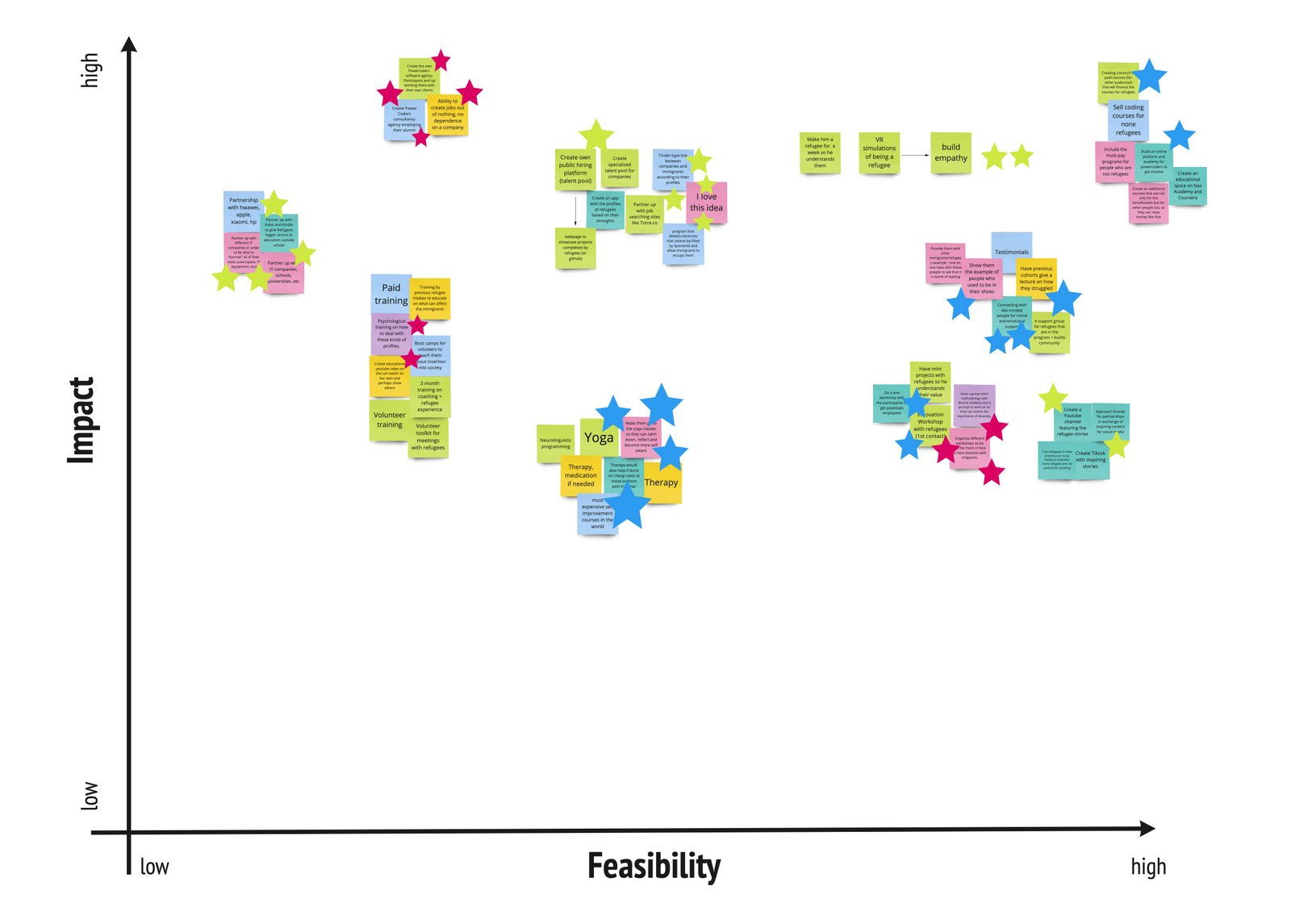
Based on these pillars, an idea portfolio of 50 ideas was created and evaluated based on feasibility and impact.
Idea Portfolio: Prototyping & Testing
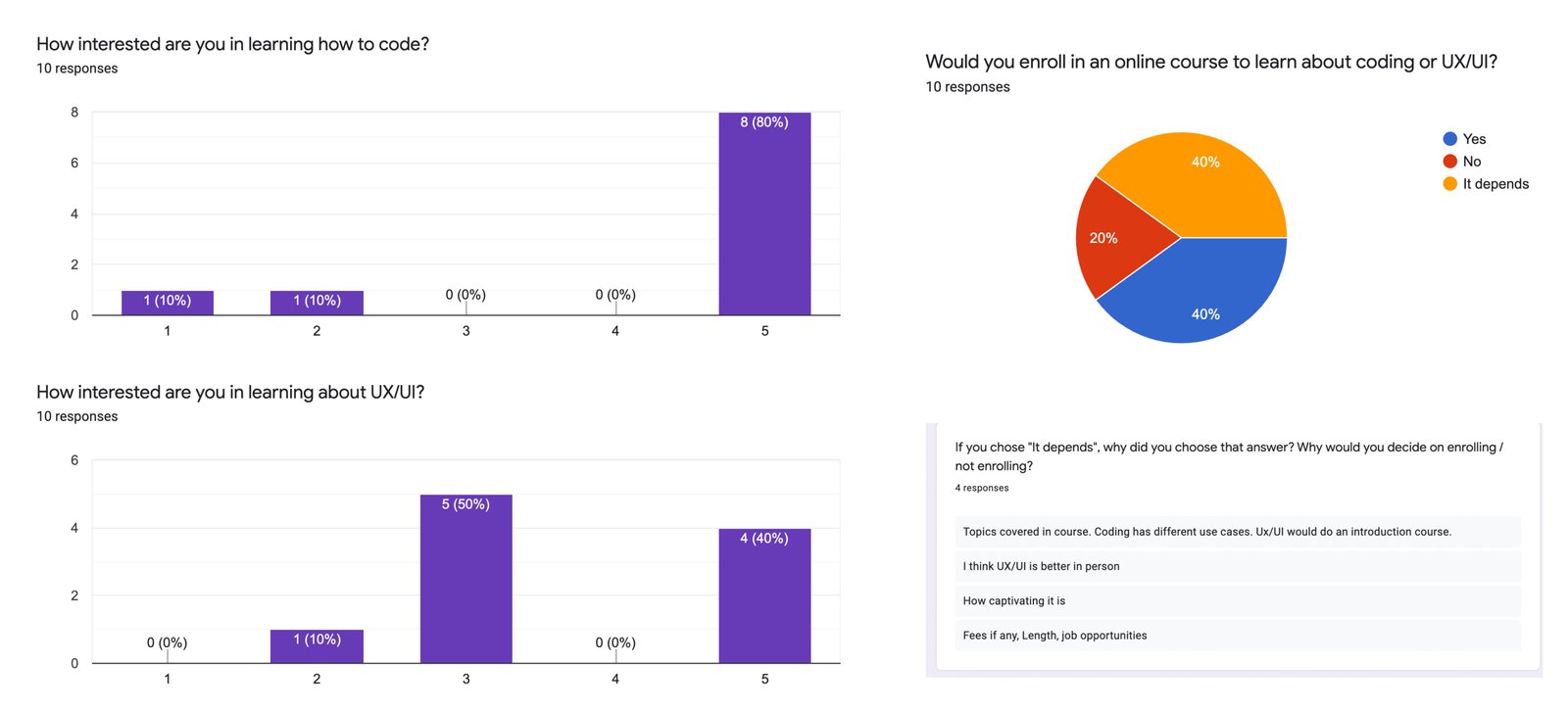
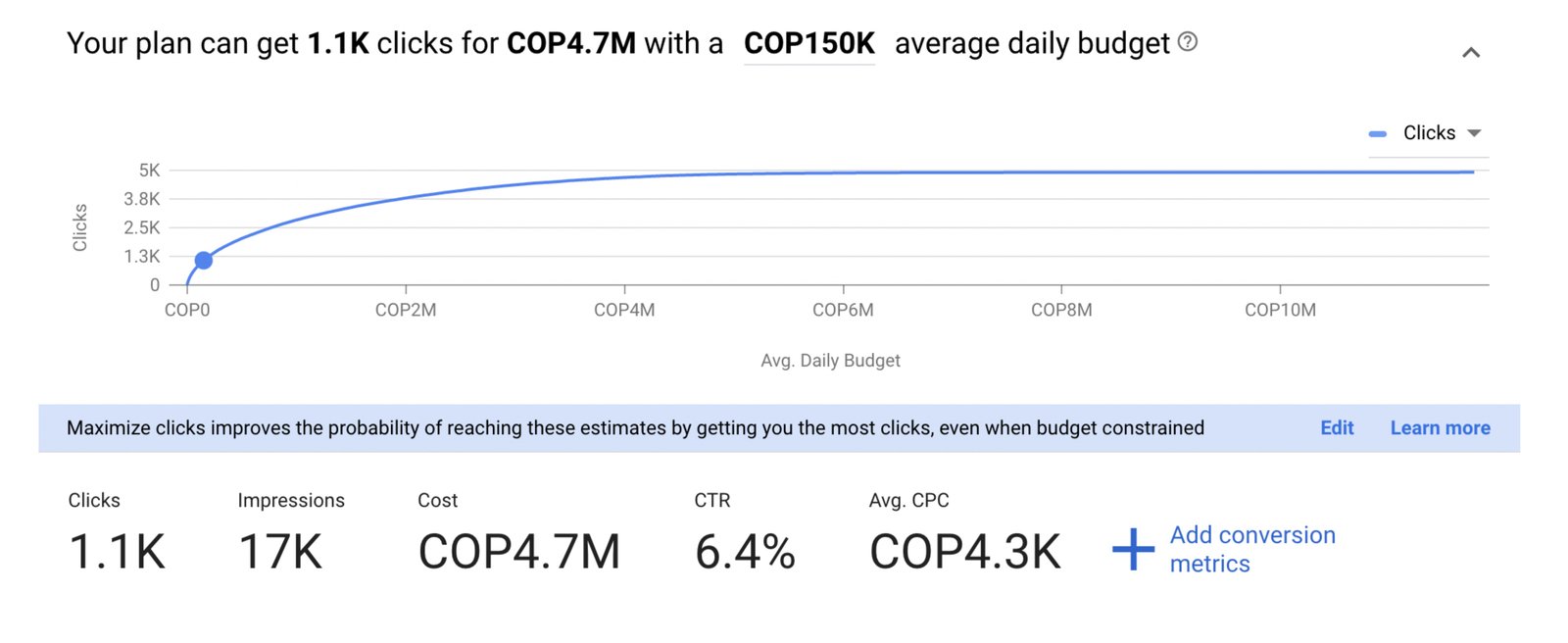
After prototyping and testing a variety of ideas, we narrowed down the portfolio. Validation included expert interviews, surveys, workshops with volunteers, benchmarking, estimating demand on Google and wireframes.
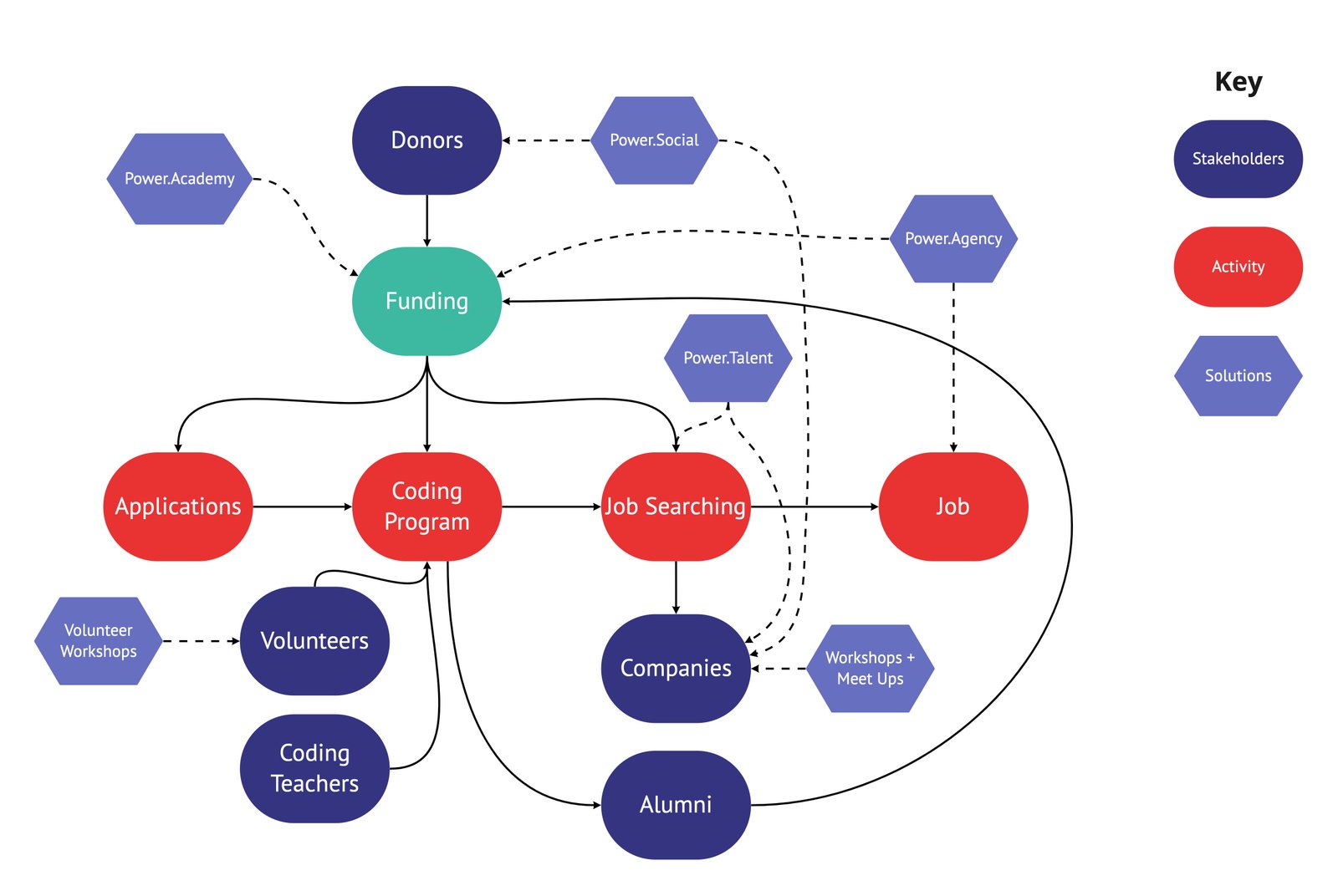
An Ecosystem Designed for Growth
Mapping the current company ecosystem and adding the solutions was the first step to understand the areas they would impact and how they would fit into the current project.
Solution Portfolio
We designed a series of solutions that tackle each pillar needed for growth:
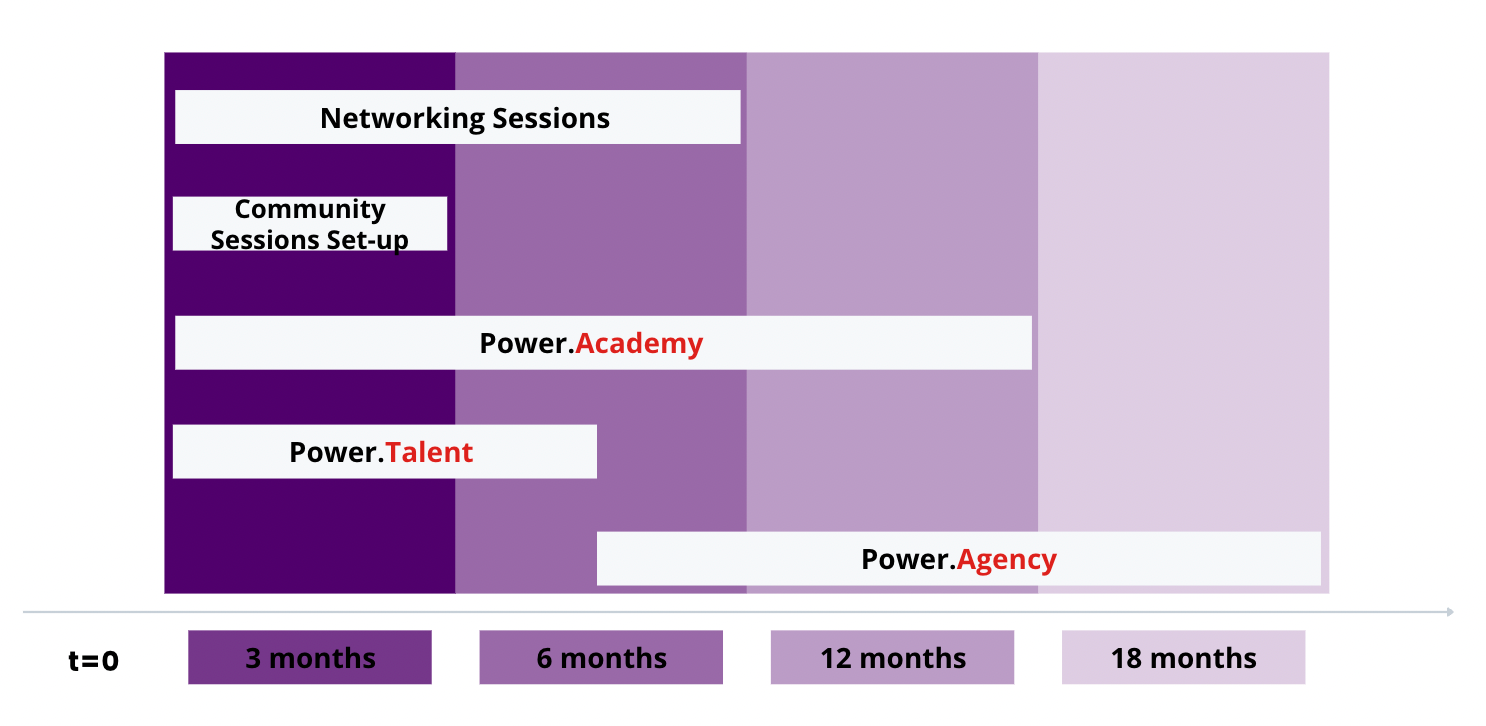
Power.Talent
Workforce Integration
A hiring platform specifically for tech profiles and companies in partnership with Power.Coders — bridging the gap between refugee talent and employers seeking tech skills.
Networking Sessions
Workforce Integration
Presentations and networking events with professionals in the field, giving participants direct exposure to the industry and potential employers.
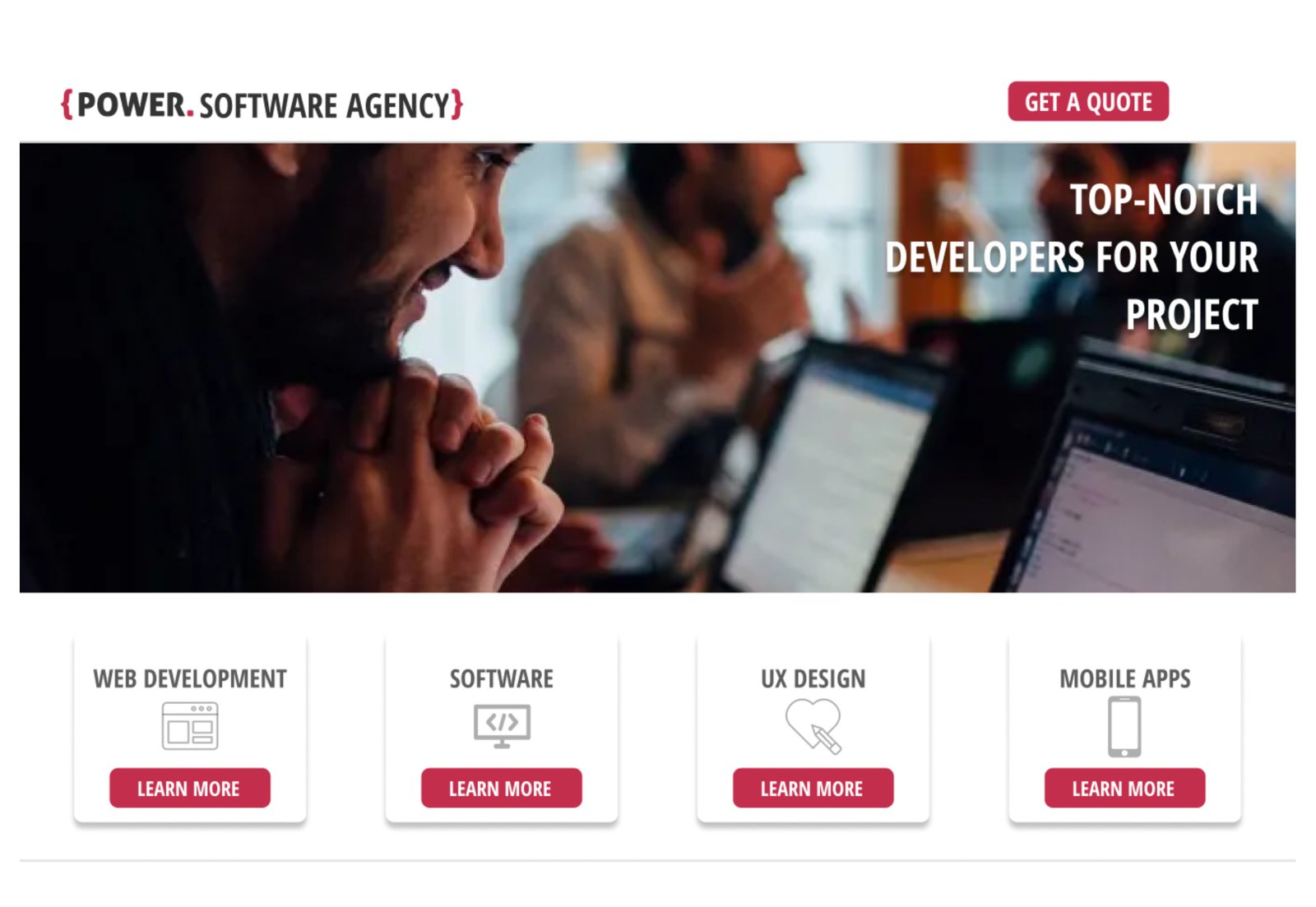
Power.Agency
Financial Resources
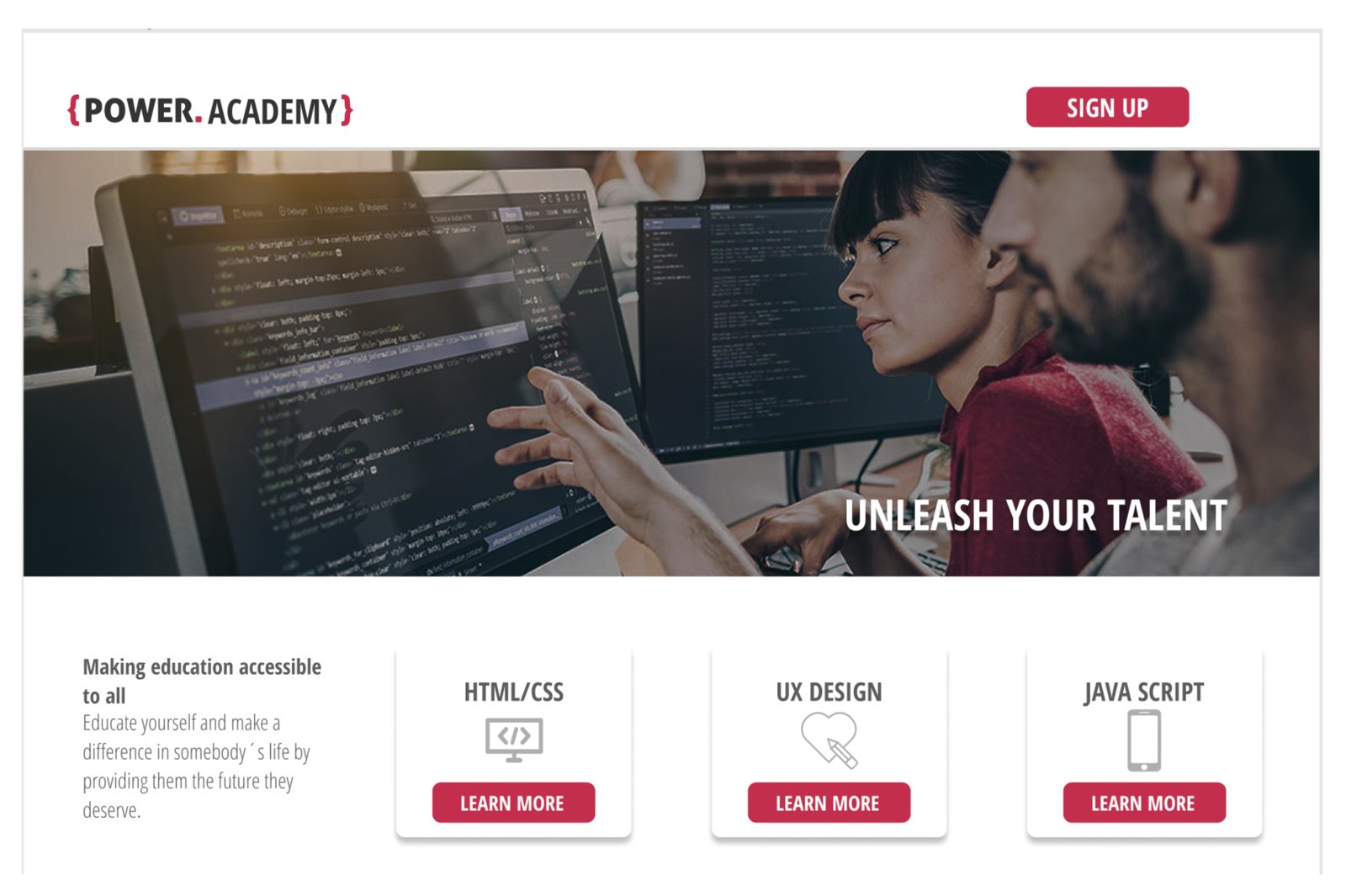
An agency run by Power.Coders graduates that reinvests its profits back into the program — creating a self-sustaining revenue loop.
Power.Academy
Financial Resources
Online courses open to the public, with proceeds directly financing the refugee program — turning knowledge into funding.
Community Programs
Community & Networking
Workshops for volunteers, support sessions between students, and coaching sessions with executives who hire refugees — strengthening every node in the ecosystem.
Implementation Timeline
The implementation of solutions was prioritized based on how quickly they could create impact, using the resources the program already has.
Key Takeaways
Challenge your beliefs
At the beginning of the project, we had a different idea about the profile of refugees in Spain, leading us to develop biased solutions. After conducting field research, we acknowledged clear misconceptions and shifted our focus right away. Research doesn't just inform — it corrects.
Growth requires systemic change
Growth requires understanding the whole system and how each part will be affected by different objectives and resource needs. When seeking growth, each area must be prepared to maintain quality in the process — the whole system must be considered.
A travel agency for visually impaired travelers — designed from research to business model through human-centered design
Role
Service & Business Designer
Context
IE Business School · Entrepreneurship
Focus
Design Thinking · SDGs · Service Design
The Challenge
THE CHALLENGE: Develop an entrepreneurship project to create a positive impact by tackling health, inequality, education, and responsible consumption — based on the UN Sustainable Development Goals.
Most travel solutions focus on majorities and leave minorities aside. For an industry with countless offerings, our aim was to find an angle where we could leverage existing infrastructure for a niche, underserved segment.
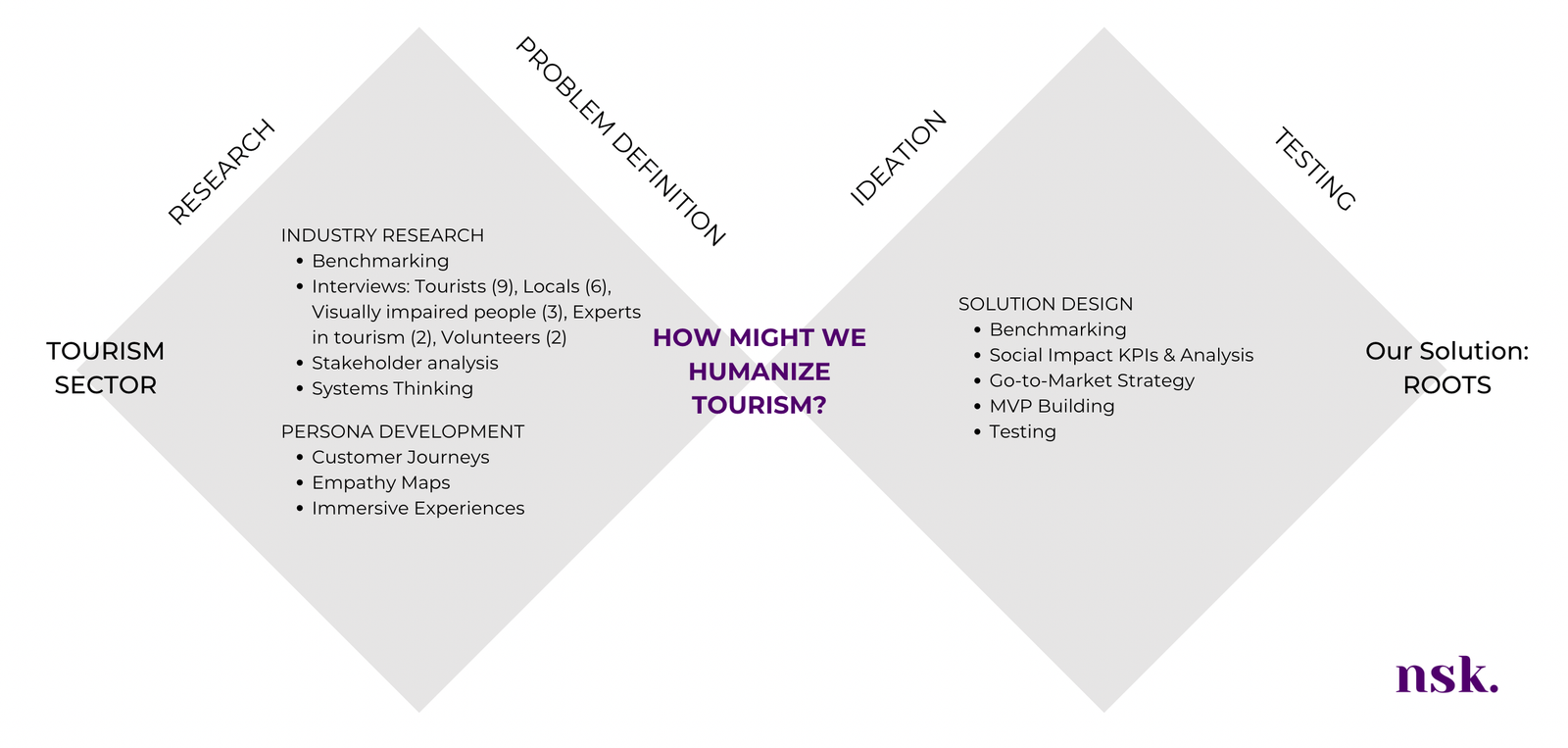
The central question: How might we humanize tourism?
The Design Process
In a team, we conducted the full design process from research to problem definition, ideation and validation. My role focused on Industry Research (stakeholder analysis and systems thinking) and Solution Ideation & Design, while providing support throughout the other phases.
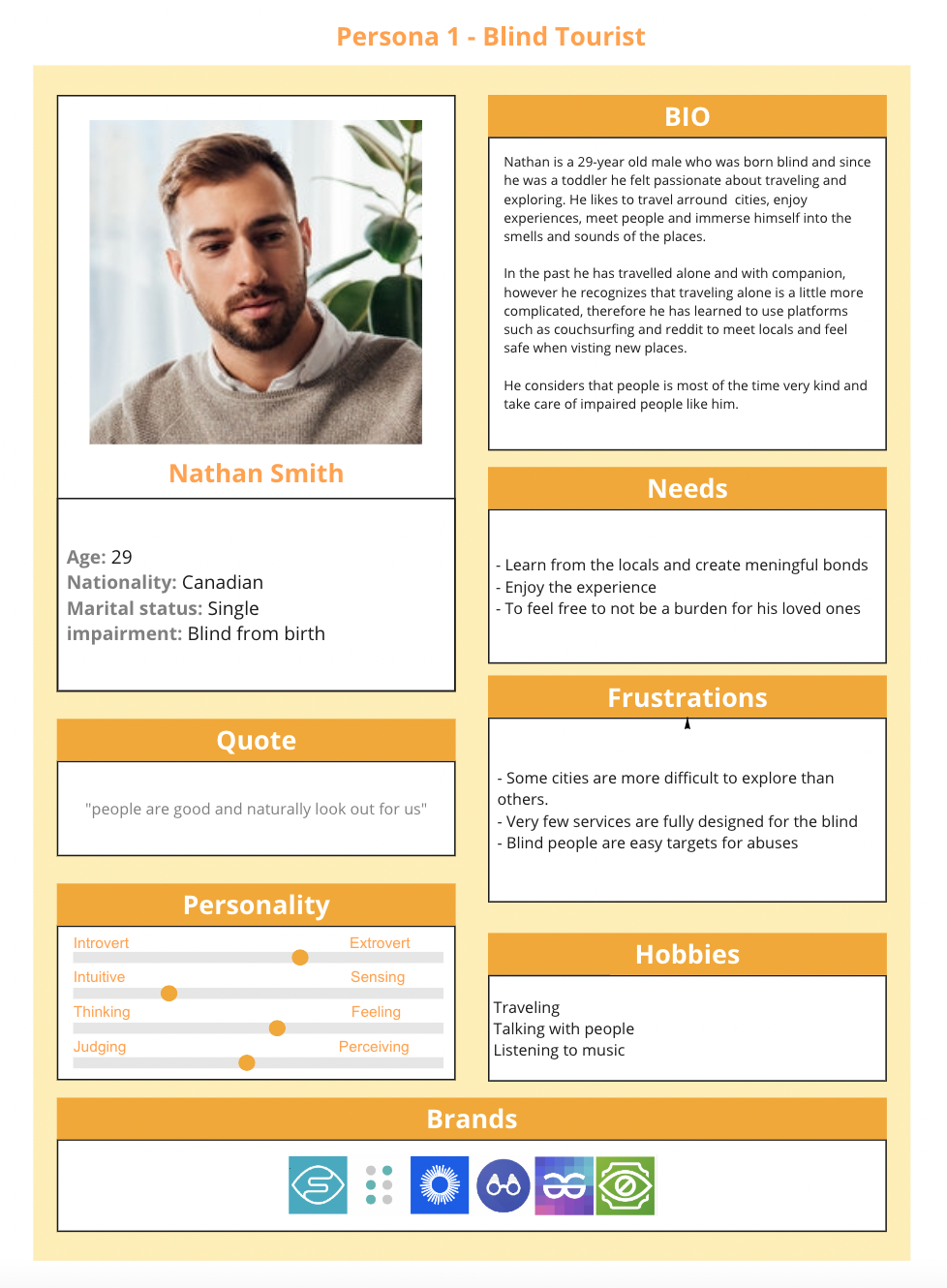
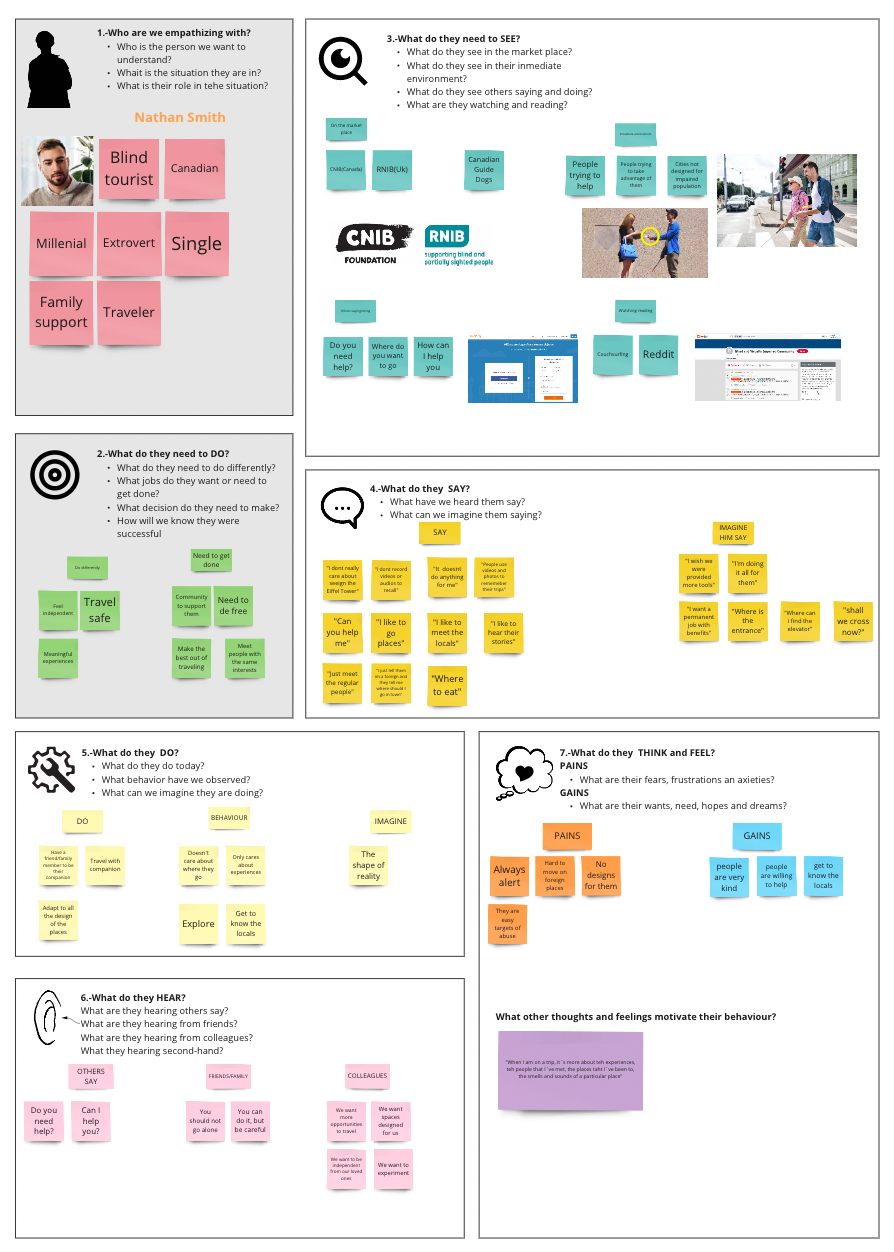
The experience was tailored towards Nathan, a young, visually impaired tourist who wants to experience the world. He hasn't found a service that provides what he needs to travel to new places and have authentic experiences with locals, while navigating accessibility limitations at each destination.
Empathy Maps
Understanding through interviews
Through empathy maps built from interviews, we were able to comprehend and design a service where travelers would feel safe through the journey — with a trusted companion, a city guide and medical assistance if needed.
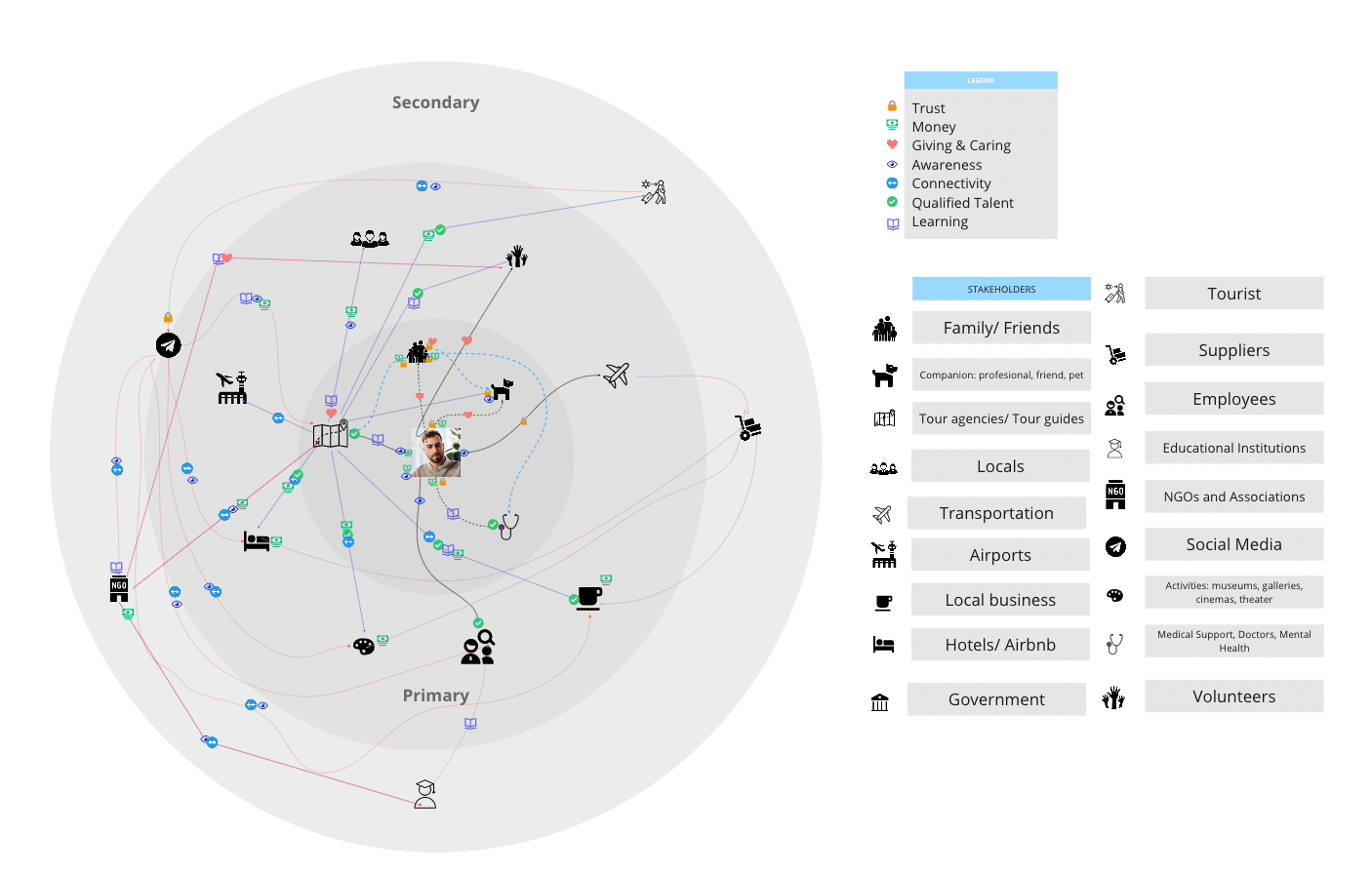
Ecosystem Maps
Mapping the stakeholders
Through the ecosystem map, we identified relevant players in the industry and focused on the core and primary ones for the service design. Companions, family members, the travel agency and medical support were the main stakeholders to include.
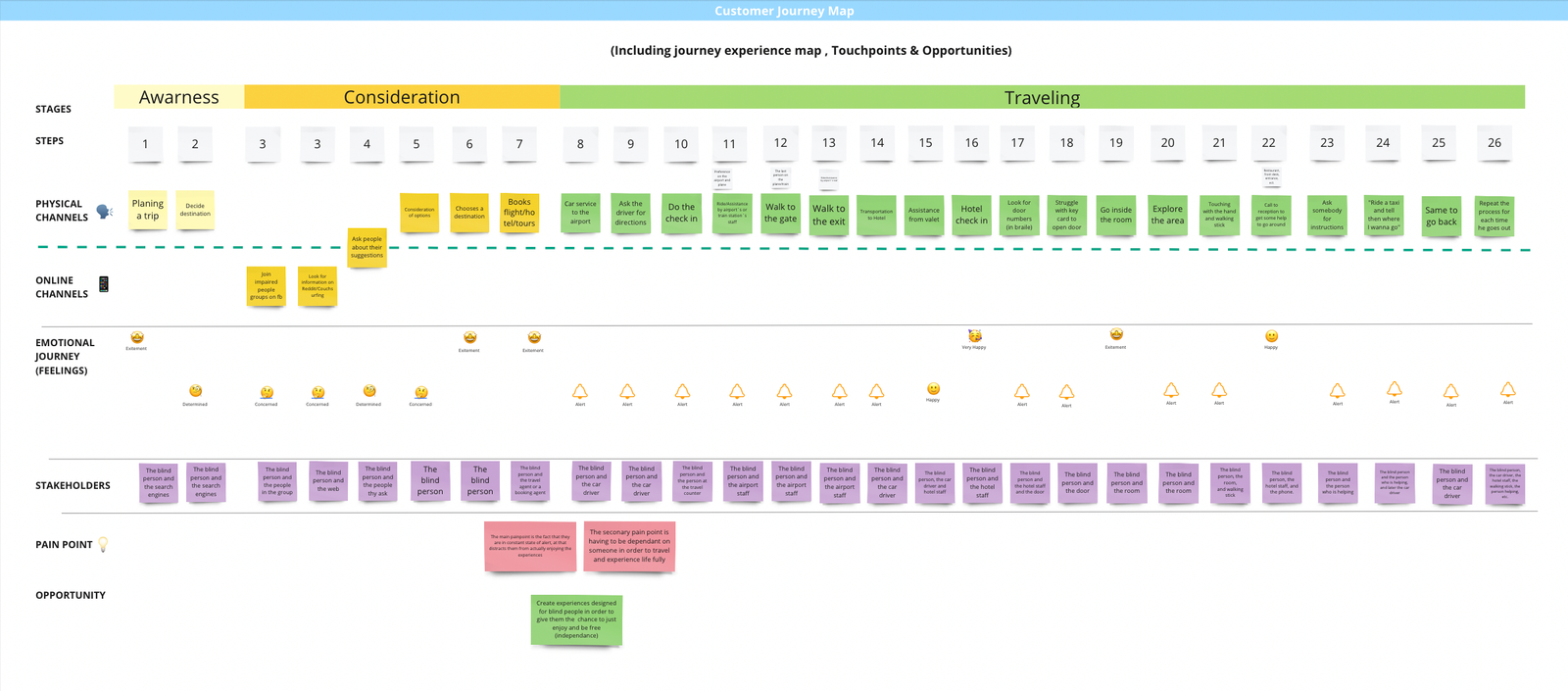
User Experience & Emotional Journeys
By analyzing the customer journey and emotional states at every step, we discovered that travelers are alert most of the time during a trip. The focus became reducing that tension throughout the tour — through proper assistance and a Welcome Kit delivered before traveling to each destination.
Key Insights
Travel is not designed for the visually impaired
They experience the world through a different set of senses and travel to feel and connect with the world around them.
People are traveling to show, not feel
Regular travelers have lost this sense of connection, making travel about boosting their "social status" rather than genuine experience.
A series of social and environmental barriers
Access to facilities, the design of spaces, lack of independence and unreliable information on destination accessibility are just some of the challenges they face.
They travel for enjoyment
Enjoyment is one of the main reasons why visually impaired tourists travel — the motivation is deeply personal and sensory.
63%
of companies reported they didn't offer accessible services
1.16×
Visually impaired tourists spend 1.16× more than average tourists
Source: Botwell, James. Journal of Tourism Futures
Value Proposition
Travel for meaningful experiences and connection
A travel agency for visually impaired travelers seeking meaningful experiences and to discover places which were previously inaccessible. We bring back the joy of traveling and connecting with destinations through the senses — creating the most meaningful, natural connections by experiencing places through their culture, joy and community.
How Does It Work?
Fill up a questionnaire about travel preferences
Get a destination proposal that best matches their interests
Receive a sensory Welcome Kit a few days before the travel date — with typical elements from the destination and an itinerary
Travel to a new destination and experience it through activities enhancing each sense
Be accompanied by medical experts and tour guides in groups of up to 10 people
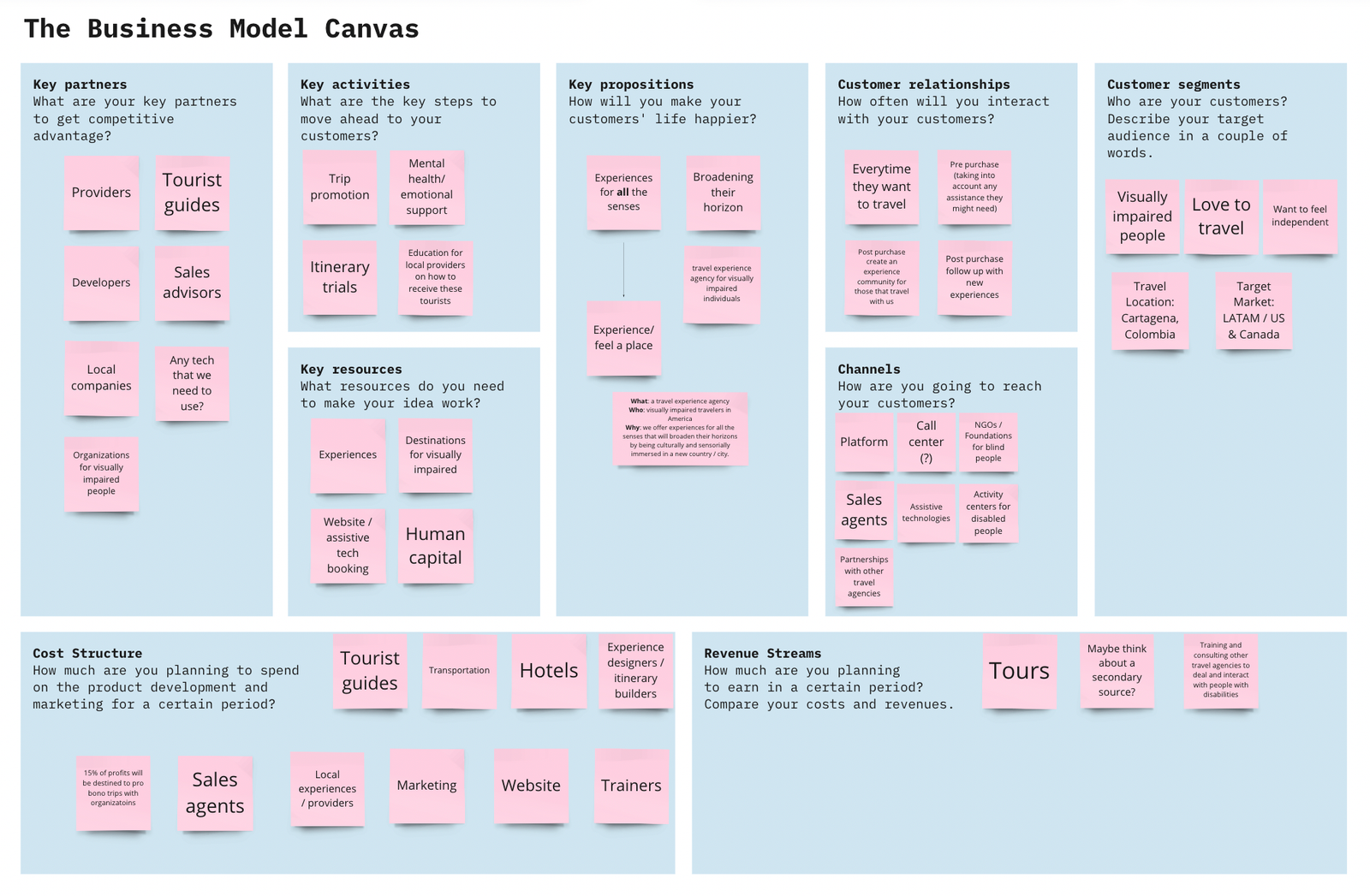
The Business Model
ROOTS is designed to work as a travel agency, with the addition of medical experts on trips and a commercial strategy focused on partnerships with institutions and schools for the visually impaired.
The growth plan includes outsourcing services to existing travel agencies with co-branding or white-label collaborations, opening a B2B revenue stream.
Market Analysis: Opening Up Latin America
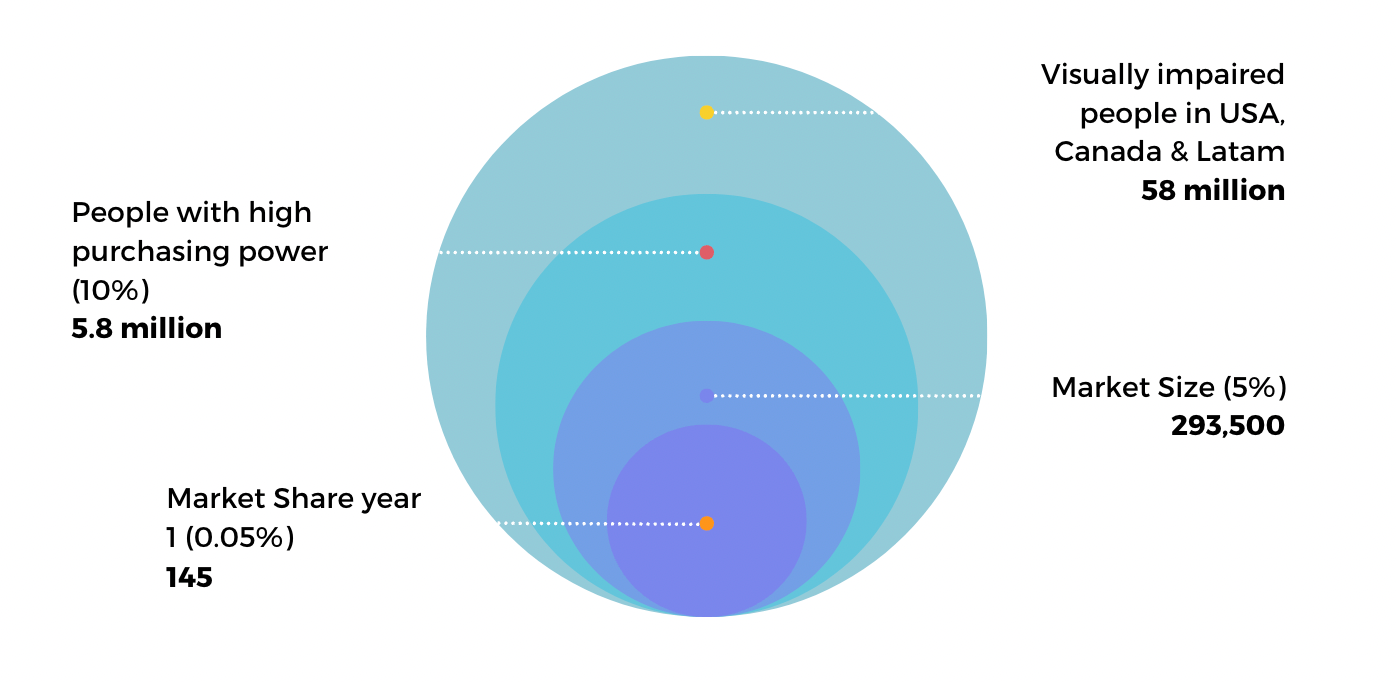
Our purpose was to open a new, niche market where visually impaired travelers could visit destinations that weren't available to them before due to infrastructure limitations.
The first destinations would be in Latin America, beginning with Colombia — one of the countries where the visually impaired need the most guidance and assistance to visit.
Key Takeaways: The Role of Empathy
Stepping into their shoes
Empathy was the main driver behind this project. The most important aspect was putting preconceptions aside, truly stepping into their shoes, understanding their feelings and how they experience the world.
Experiencing the world through other senses
Visually impaired people don't feel impaired — they experience the world through other senses. This experience was built to create opportunities for those who live and connect with the world differently.
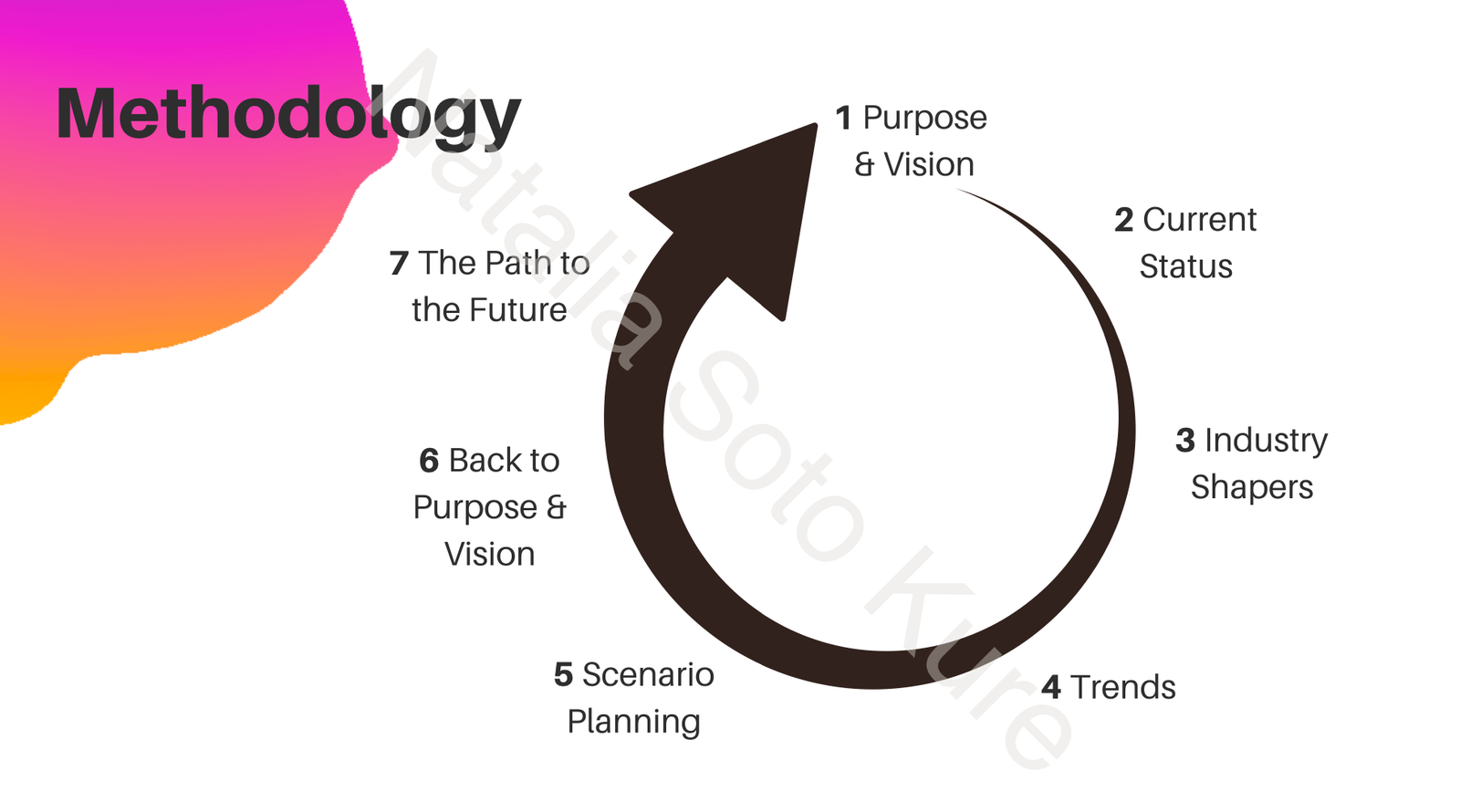
How might we design a futures methodology that helps purpose-driven companies envision — and build toward — the future scenarios where their brand, products and services can thrive?
Why Purpose Matters
From my experience in consulting and marketing, companies that perform best are those that have a common purpose in mind — teams are more aligned and motivated, products and services respond to a common cause, and brands create a certain identity and credibility related to their purpose.
As a result, customers connect with the brand for reasons far beyond their offerings. This methodology is designed for brands that seek to change the world and imagine a future of possibilities related to their purpose.
What the Methodology Delivers
Step-by-Step Process
A structured framework for designing future scenarios and the products and services to thrive within them — grounded in the company's core purpose.
Templates & Tools
Ready-to-use canvases and worksheets to work through each stage — from trend scanning to scenario building to opportunity design.
Purpose as North Star
Every step is anchored to the company's purpose — ensuring that future products, services and strategies reinforce the brand's reason for being.
The Framework
The methodology follows a structured progression from understanding the present to designing for the future — always anchored to the company's purpose:
01
Define Purpose
Articulate the company's core reason for being — the foundation that will guide every strategic decision.
02
Scan the Landscape
Map trends, signals and drivers of change across technology, culture, regulation and markets.
03
Build Scenarios
Develop plausible future worlds where these trends converge — exploring both opportunities and threats.
04
Identify Opportunities
Within each scenario, find the spaces where the company's purpose creates unique value.
05
Design Products & Services
Translate opportunities into tangible concepts — products, services and experiences ready for validation.
06
Roadmap & Activate
Build a phased plan to bring the most promising concepts to life — from quick wins to long-term bets.
Inside the Methodology
A visual walkthrough of the methodology's key canvases and tools:
Key Takeaways
Purpose is a competitive advantage
Purpose-driven companies don't just adapt to the future — they shape it. When purpose guides strategy, every product and service becomes an expression of a larger mission that customers, employees and partners rally behind.
The future is designable
Rather than passively reacting to change, companies can actively design for it. By combining trend analysis, scenario thinking and human-centered design, we turn uncertainty into a canvas of opportunity.
Whether you're launching a new product, rethinking your customer experience or need a fresh perspective on innovation strategy — I'd love to hear about it.